

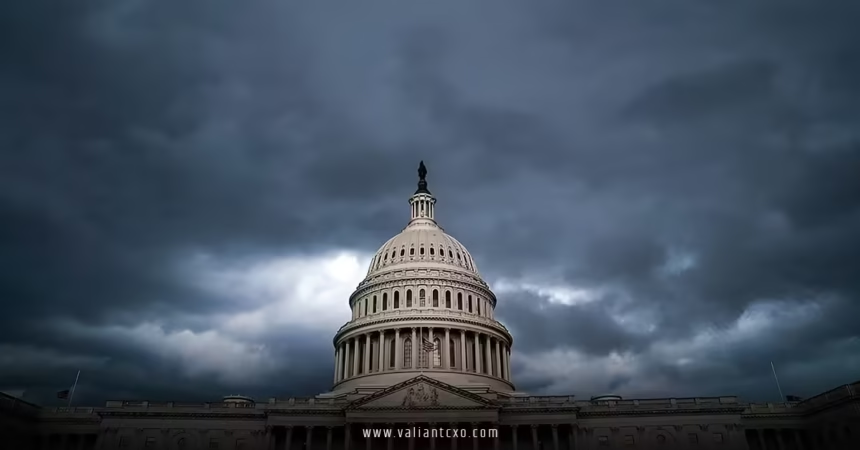
U.S. Senate government shutdown negotiations 2025 have hit a fever pitch, with just days left before the funding cliff on September 30. Picture this: the marble halls of Capitol Hill, usually buzzing with deal-making and backroom handshakes, now feel like a high-stakes poker game where everyone’s bluffing with the nation’s wallet on the line. As a guy who’s followed these political thrillers for years, I can’t help but wonder—will our leaders fold, or will they go all in and risk shutting down the government that keeps America running? It’s not just wonky budget talk; it’s about real lives hanging in the balance, from federal workers staring at empty paychecks to veterans wondering if their benefits will vanish overnight.
Let’s dive in, shall we? I’ll break it down like we’re chatting over coffee, no jargon overload, just the facts laced with a bit of that raw, human edge that makes politics pulse. By the end, you’ll see why these U.S. Senate government shutdown negotiations 2025 aren’t just headlines—they’re a mirror to our divided house.
The Backstory: How We Got to U.S. Senate Government Shutdown Negotiations 2025
Remember when Congress was supposed to wrap up the fiscal year like pros, passing budgets months in advance? Yeah, that ship sailed ages ago. Fast-forward to September 2025, and here we are, teetering on the edge of another shutdown because, well, politics. The fiscal year ends September 30, and without a new spending bill, non-essential government operations grind to a halt. It’s like your car running out of gas on a deserted highway—frustrating, unnecessary, and way too familiar.
This isn’t the first rodeo. We’ve danced this tango before, from the 2018-2019 epic 35-day shutdown over border walls to shorter spats in 2021. But U.S. Senate government shutdown negotiations 2025 feel different, charged with the fresh energy of a post-election landscape where Republicans hold the House, Senate, and White House under President Trump. Democrats, now in the minority, are digging in their heels, refusing to rubber-stamp what they call “poison pill” cuts. It’s a classic standoff: one side yelling “fiscal responsibility,” the other screaming “protect the vulnerable.”
Why now? Blame it on the “Big, Beautiful Bill”—that massive spending package from earlier this year that slashed foreign aid, public broadcasting funds, and healthcare subsidies. Democrats want reversals; Republicans say, “Deal with it.” As negotiations drag, the Senate’s 60-vote filibuster threshold looms like a grumpy gatekeeper, demanding bipartisanship that feels as rare as a unicorn these days.
Key Players Shaping U.S. Senate Government Shutdown Negotiations 2025
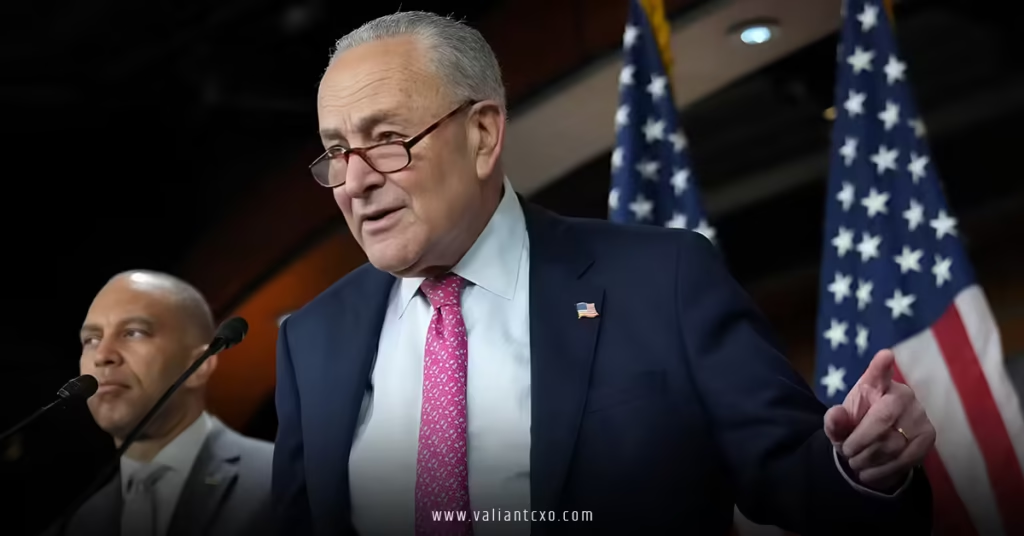
Who are the gladiators in this arena? Let’s meet the crew steering the U.S. Senate government shutdown negotiations 2025. At the top, you’ve got Senate Majority Leader John Thune (R-SD), the cool-headed tactician pushing for a quick fix, and Minority Leader Chuck Schumer (D-NY), the fiery New Yorker who’s not afraid to call out what he sees as Republican bullying.
Don’t sleep on House Speaker Mike Johnson (R-LA), who’s been twisting arms in the lower chamber to pass bills that land like lead balloons in the Senate. Then there’s President Trump himself, tweeting fire and brimstone, urging his party to hold the line while hinting at talks with Democrats. His recent nod to meeting Schumer and House Minority Leader Hakeem Jeffries? That’s the wildcard—could it be a genuine olive branch or just theater to shift blame?
On the Hill, outliers like Sen. John Fetterman (D-PA), who bucked his party to vote for the House bill, add that burst of unpredictability. And Rand Paul (R-KY)? He’s the libertarian thorn, voting against his own side’s measure because, in his words, “any spending is too much.” These folks aren’t just names; they’re the human sparks igniting or dousing the flames of U.S. Senate government shutdown negotiations 2025.
Republicans’ Hardline in U.S. Senate Government Shutdown Negotiations 2025
Republicans are playing the “keep it simple” card. Their pitch? A clean continuing resolution (CR) bumping funding to November 21, no frills, no fights. It’s like ordering plain toast when the menu’s loaded with gourmet options—they want to avoid the kitchen drama. House Republicans rammed this through 217-212, adding a sprinkle of $88 million for security amid rising threats to lawmakers (think that scary Charlie Kirk incident). But in the Senate? Crickets. Only 44 votes, far short of 60.
Trump’s shadow looms large here. He’s publicly told Thune and Johnson, “Don’t negotiate with Democrats,” echoing his Art of the Deal vibes but risking a full shutdown. White House spokesperson Karoline Leavitt doubled down, pinning any mess on Dems. It’s bold, but is it brinkmanship or just bad math?
Democrats’ Counterpunch in U.S. Senate Government Shutdown Negotiations 2025
Flip the script, and Democrats are the underdogs with everything to lose. Their alternative CR? Fund through October 31, but with riders to restore Obamacare subsidies, reverse Medicaid cuts, and pump $500 million back into NPR. It’s their “protect the people” manifesto, failing 47-45 in the Senate because, surprise, Republicans boycotted the vote.
Schumer’s leading the charge, penning letters to Trump begging for a sit-down. “This is a Republican healthcare crisis,” he thunders, pointing to premium hikes that could jack up costs for millions. Jeffries echoes from the House, warning that a shutdown hurts seniors, vets, and military families most. Their strategy? Leverage public outrage, painting Republicans as the villains who won’t budge. Smart? Maybe. Desperate? You bet.
The Proposals Clashing in U.S. Senate Government Shutdown Negotiations 2025
At the heart of U.S. Senate government shutdown negotiations 2025 are two bills that couldn’t be more different if they tried. The GOP’s “clean” CR is vanilla ice cream—safe, predictable, extending current levels with a security boost. No policy tweaks, just buy time for the real budget battles later. It’s passed the House, but Senate Dems see it as a Trojan horse smuggling in Trump’s earlier cuts, like slashing foreign aid and clawing back billions unilaterally.
Democrats’ counter? Chocolate fudge with all the toppings. Their four-week extension packs in healthcare fixes: permanent ACA tax credits to shield folks from 15-year-high premium spikes, Medicaid protections for low-income families, and that NPR lifeline. They argue it’s not greed; it’s necessity. After all, who wants to fund a government that lets veterans’ checks bounce?
Both bombed in the Senate last week—GOP bill 44-48, Dems’ 47-45. With Congress jetting off for Rosh Hashanah recess, extending past the deadline, it’s staffers in smoke-filled rooms (okay, Zoom calls) who might salvage this. As Capitol Hill correspondent Mitchell Miller put it, “The viable path to avoiding a shutdown… it’s really almost closed.” Ouch. But hey, never say never—last-minute miracles are Congress’s specialty.
Hidden Agendas Lurking in U.S. Senate Government Shutdown Negotiations 2025
Peel back the layers, and you’ll spot the real knives. Republicans whisper about tying in DOGE (Department of Government Efficiency) initiatives—those Elon Musk-inspired cuts to “waste.” Democrats counter with demands for DACA protections and green energy funds. It’s not just money; it’s ideology. Trump’s pocket vetoes on aid packages have Dems fuming, while GOP hardliners eye this as leverage for border security boosts.
One X post buzzing lately claims Schumer’s pushing free insurance for undocumented folks and a $1.5 trillion spend-a-thon. Hyperbole? Sure, but it fuels the fire. Public sentiment on X is a wildfire—half cheering Trump’s tough stance, half decrying Dems for “holding the country hostage.”
Trump’s Wild Card Role in U.S. Senate Government Shutdown Negotiations 2025
Enter the Donald, the ultimate disruptor in U.S. Senate government shutdown negotiations 2025. He’s been blasting Dems on Truth Social, calling their demands “insane” and floating a shutdown as “no big deal.” Yet, sources say he’s greenlighting a Thursday powwow with Schumer and Jeffries. “I’d love to meet,” he told Fox, but added the skeptical kicker: “I don’t think it’s going to have any impact.”
Why the flip? Blame game, baby. The White House is prepping to finger Dems if lights go out October 1, citing their rejection of a “simple, clean budget.” Trump’s history? He owns the longest shutdown ever, but now, with full control, a flop would sting. This meeting could be the pressure valve—imagine the analogies: two bulls in a china shop, or maybe a bizarre family reunion where everyone’s armed with spreadsheets.
Analysts whisper it’s theater, but I see glimmers. Trump thrives on chaos, but he hates losing. If he twists arms for a compromise, it could extend funding with a nod to security and a healthcare olive branch. Or, it backfires, and we’re in shutdown city.
What a Shutdown Means: Real-World Ripples from U.S. Senate Government Shutdown Negotiations 2025
Let’s get real—U.S. Senate government shutdown negotiations 2025 aren’t abstract. If they flop, it’s lights out for 2 million federal workers, furloughed without pay (though backpay comes later). National parks close, IRS refunds delay, food inspections halt. Vets? Their claims pile up; military families scrape by.
Economists peg the cost at $1-2 billion weekly, like a slow bleed on GDP. Contractors? Frozen in limbo, no new deals, payments stalled. And the vulnerable—seniors on delayed Social Security checks, kids losing Head Start spots—feel it hardest. It’s not Armageddon, but it’s a gut punch, eroding trust in the system we all fund.
Rhetorical question: Is this the “efficiency” we voted for, or just Washington gridlock on steroids? From my vantage, it’s a reminder that government isn’t a video game; pause it, and real people glitch.
Economic Tsunami: Broader Fallout of Failed U.S. Senate Government Shutdown Negotiations 2025
Zoom out, and the waves hit Wall Street. Markets hate uncertainty—stocks dip, bonds wobble, as investors eye delayed data from the Fed. Small businesses reliant on SBA loans? Screwed. And globally? Allies question U.S. reliability when aid dries up, emboldening foes.
But silver lining? Shutdowns spark urgency. Remember 2019? It birthed border deals. If U.S. Senate government shutdown negotiations 2025 crash, it might force a full-year budget by December, with reforms. Or not. History’s a mixed bag.
Pathways Forward: Can U.S. Senate Government Shutdown Negotiations 2025 Salvage the Day?
Optimism’s thin, but paths exist. Scenario one: Trump’s meeting yields a hybrid CR—seven weeks funding, security bucks, and a healthcare study group. Bipartisan enough for 60 Senate votes? Possible, if egos bend.
Scenario two: Staffer magic. While bosses golf, aides haggle over a “grand bargain” blending cuts with protections. Miller calls it the “glimmer of hope.”
Worst case? Shutdown kicks in October 1, 12:01 a.m. Essential services chug—Border Patrol, SS payments—but the rest? Barricades and IOUs. Congress reconvenes mid-week, but damage mounts.
My take? Pressure from constituents—think viral X rants and town hall boos—could tip it. We’re the bosses here; let’s act like it.
Lessons from Past U.S. Senate Government Shutdown Negotiations 2025 Echoes
Flashback to 2018: 800,000 feds off payroll, longest shutdown ever. It ended in tears, no wall funding. Fast-forward, and 2025 mirrors it—ideology over pragmatism. But this time, with Trump 2.0, the stakes feel higher, the rhetoric sharper. What if we learned? Prioritize people, negotiate early. Nah, too sensible.
Wrapping Up U.S. Senate Government Shutdown Negotiations 2025: A Call to Action
So, there you have it—the raw, riveting saga of U.S. Senate government shutdown negotiations 2025. From clashing proposals and Trump’s tango with Dems to the gut-wrenching impacts on everyday folks, it’s a tale of power, pride, and the push for compromise. We’ve seen the players, the plays, and the perils; now, as the clock strikes midnight on September 30, will wisdom prevail or will we pay the price?
Don’t just scroll past—get involved. Hit up your senators, amplify voices on X, demand better. Because in this democracy, silence is complicity. Let’s turn this near-miss into a masterclass in governance. What’s your move?
For deeper dives, check out Federal News Network’s shutdown coverage, NBC News on Senate votes, and CBS on Trump’s meetings.
Frequently Asked Questions About U.S. Senate Government Shutdown Negotiations 2025
What exactly is at stake in the U.S. Senate government shutdown negotiations 2025?
At its core, these talks are about passing a spending bill by September 30 to keep federal agencies humming. Failure means furloughs, delayed services, and economic jitters—think parks closed and paychecks paused for millions.
How is President Trump influencing the U.S. Senate government shutdown negotiations 2025?
Trump’s directing traffic, pushing Republicans for a clean bill while scheduling chats with Dem leaders. His “no negotiations” stance adds heat, but a potential breakthrough meeting could cool things down—or ignite more drama.
Will a government shutdown from U.S. Senate government shutdown negotiations 2025 affect my Social Security check?
Good news: Mandatory programs like Social Security keep rolling during shutdowns. But processing delays could snag future benefits, so stay vigilant.
Why are Democrats so dug in during U.S. Senate government shutdown negotiations 2025?
They’re fighting to reverse healthcare cuts that hike premiums and slash Medicaid. It’s not obstruction; it’s safeguarding access for families who can’t afford the fallout.
What’s the likelihood of avoiding a shutdown in U.S. Senate government shutdown negotiations 2025?
Slim but not zero—staffers and Trump’s talks offer hope. History shows last-second saves, but with recesses and filibusters, odds lean toward turbulence.
For More Updates !! : valiantcxo.com

