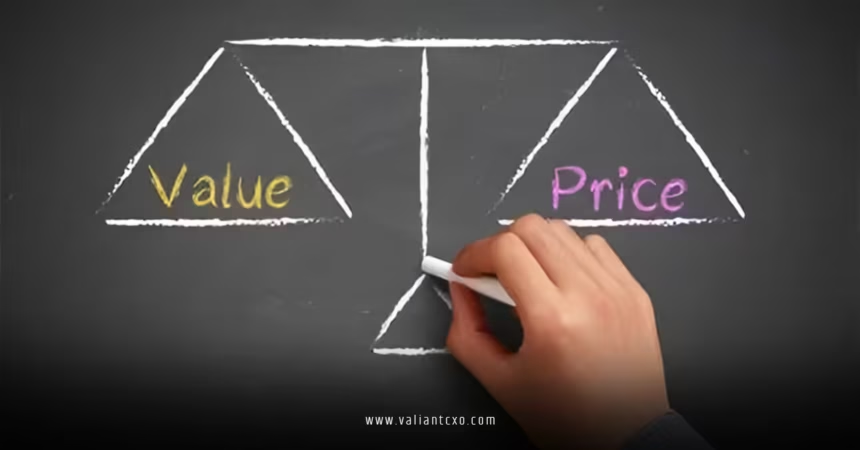
If you run a small business, you’ve probably wrestled with the same worry: “Am I charging the right price?” Maybe you’ve lost deals because you were “too expensive,” or felt resentful after doing way more work than the invoice reflects. Cost-plus pricing (adding a margin on top of your costs) and matching competitors can feel safe, but they rarely reflect the true value you deliver.
That’s where value-based pricing for small businesses comes in. Instead of asking, “What does this cost me?” you ask, “What is this worth to my customer?” And that shift can transform your revenue, your positioning, and your confidence. To see this in action at the extreme, look at the Gus T-Rex fossil Sotheby’s auction record $50 million — a perfect example of how perceived value, rarity, and story can push prices far beyond raw cost.
In this article, we’re going to be taking a look at value-based pricing for small businesses, and how you can use ideas like the Gus T-Rex fossil Sotheby’s auction record $50 million to build a smarter, more profitable pricing strategy. If you would like to find out more, feel free to read on.
Pic – CC0 License
What Is Value-Based Pricing for Small Businesses?
Value-based pricing for small businesses means setting your prices based on the benefits and outcomes you create for your customers, not just your time, materials, or overheads.
Instead of charging:
- An hourly rate
- A simple mark-up on costs
- Whatever your competitors are charging
You work out how much impact your product or service has on your customer’s life or business, and price relative to that impact.
For example, if your marketing work regularly generates $50,000 in new sales for a client, charging $500 isn’t “competitive” — it’s leaving money on the table. Value-based pricing helps you align your price with the transformation you provide, which makes your offer feel fair and powerful to the right clients.
What Gus T-Rex Teaches Us About Perceived Value
The Gus T-Rex fossil Sotheby’s auction record $50 million wasn’t about the “cost” of bones and excavation. It was about what owning that fossil meant to the buyer. Status, rarity, history, and long-term cultural and financial value all blended into one big number.
That auction is an extreme version of what happens every day in your market:
- Two businesses sell similar services.
- One charges a budget price and gets squeezed.
- The other positions itself as high-value, tells a clear story, and charges a premium.
Gus was priced based on perceived value, not cost. As small business owners, we can borrow that logic. Your clients aren’t paying for hours or ingredients; they’re paying to solve a problem, avoid a headache, save time, look better, sell more, or feel more secure.
When you start seeing your work through that lens, value-based pricing for small businesses stops being a theory and starts feeling like common sense.
Step 1: Understand the Outcomes You Create
We’re going to be honest: you can’t do value-based pricing if you’re vague about the results you deliver. Your first job is to get crystal clear on outcomes.
Ask yourself:
- What measurable results do my clients get? (More leads, fewer errors, saved hours, higher retention)
- What emotional benefits do they get? (Peace of mind, confidence, status, relief)
- What risks or costs do I help them avoid?
Write these down for each offer you have. The more specific you are, the easier it becomes to price based on value.
For example:
- A bookkeeper might save a client 10 hours a month and avoid tax penalties.
- A designer might help a client close more deals because the brand finally looks credible.
- A coach might help a founder avoid burnout and grow revenue by 30%.
Those are all value stories, not cost stories.
Step 2: Talk to Your Customers About Value, Not Price
Value-based pricing for small businesses thrives on conversations, not guesses.
We encourage you to talk directly to your customers and ask:
- “What changes most in your business or life because of this service?”
- “If we solved this problem for you completely, what would that be worth in dollars?”
- “What would it cost you if this problem remained unsolved for another year?”
You’ll often hear answers that surprise you. Clients might say things like, “Honestly, this saves me hiring a full-time role,” or “This increases my conversion rate enough to pay for itself many times over.”
Those comments are gold. Use them:
- In your marketing copy
- In your proposals
- In your pricing conversations
They anchor the discussion in value, which makes your fees feel logical instead of arbitrary.
Step 3: Design Offers Around Value, Not Hours
One reason many small businesses undercharge is that they sell time blocks instead of outcomes. Hourly rates make clients focus on the clock. Outcome-based offers make them focus on results.
To apply value-based pricing for small businesses, reshape your packages:
- Name your services around the outcome (“Launch-Ready Branding Package” vs. “20 Hours of Design”).
- Define what success looks like (e.g., “We will redesign your website to increase conversion, with analytics tracking included.”).
- Bundle what’s required to deliver that success, even if it’s hard to break down by hours.
This doesn’t mean you never track your internal time; it just means your client sees a complete solution, not a time sheet. When they feel confident you’ll deliver the outcome, they care less about the line items and more about whether the result is worth the price.
Step 4: Anchor Your Prices Against the Value You Create
Here’s where we borrow a quiet trick from high-value auctions like the Gus T-Rex fossil Sotheby’s auction record $50 million.
At that auction, there were expectations set before bidding even started: expert estimates, comparisons to previous record sales, and a narrative about how rare this opportunity was. For your business, you can do something similar by anchoring your price against the value.
Examples:
- “On average, campaigns like this generate an extra $100,000–$150,000 in revenue in the first year. Our fee is $15,000.”
- “This system replaces a full-time role that would cost you at least $60,000 a year. Our implementation fee is $8,000.”
- “Our clients typically save 200 hours annually with this solution. If your time is worth $100/hour, that’s $20,000 saved. Our annual fee is $4,000.”
You’re not just blurting out a number. You’re showing how the value frame makes the price feel reasonable, even attractive.
Step 5: Be Willing to Walk Away From Wrong-Fit Clients
Value-based pricing for small businesses requires confidence and boundaries.
Not everyone will be ready or able to pay for value. Some buyers only ever shop on price. That’s okay — but they may not be the right buyers for you.
We suggest:
- Holding your pricing line for your core offers.
- Offering a smaller, clearly scoped option if someone genuinely can’t afford your main package.
- Politely walking away from prospects who want premium results at bargain-bin prices.
High-value assets, like Gus, don’t get wheeled into discount outlets. They’re showcased in spaces that respect their worth. Your business deserves the same respect, starting with how you treat it yourself.
Common Mistakes to Avoid
When shifting to value-based pricing for small businesses, watch out for these traps:
- Underselling your impact. You assume your work is “simple” because it’s easy for you, but it’s hard for your clients.
- Racing to discount. You drop your price as soon as someone hesitates, instead of clarifying the value.
- Lack of proof. You talk about value without backing it up with testimonials, case studies, or metrics.
- Inconsistent messaging. You say you’re high-value but your brand, website, and proposals look low-effort.
Stay aware of these, and adjust. Your goal is to make your value obvious and credible so your pricing feels natural.
Putting Value-Based Pricing Into Practice This Month
We’re going to keep this very practical. Here’s how you can start implementing value-based pricing for small businesses in the next 30 days:
- List your top 3–5 offers.
- For each, write down the main outcomes you deliver — in dollars, time, risk, or emotional benefit.
- Rewrite your offer descriptions to focus on those outcomes.
- Adjust your pricing to sit comfortably within a fair share of the value you create.
- Update your proposals and sales conversations to anchor your price against that value, just like high-value assets in headline auctions.
You’ll likely feel some discomfort at first. That’s normal. Pricing is as much a mindset shift as it is a strategy change. But once you see a few clients happily paying value-based prices — and getting great results — you’ll wonder why you waited so long.
We hope that you have found this article enlightening in some way, and that value-based pricing for small businesses feels both achievable and exciting for your next stage of growth. The same principles that helped the Gus T-Rex fossil Sotheby’s auction record $50 million can work in your world: frame your value clearly, package outcomes, and have the confidence to stand by your worth.
You’re not just selling time or materials; you’re selling results, relief, and opportunity. When you price accordingly, you protect your margins, attract better-fit clients, and build a business that feels rewarding instead of draining. Your work already has value — it’s time your pricing reflected it.