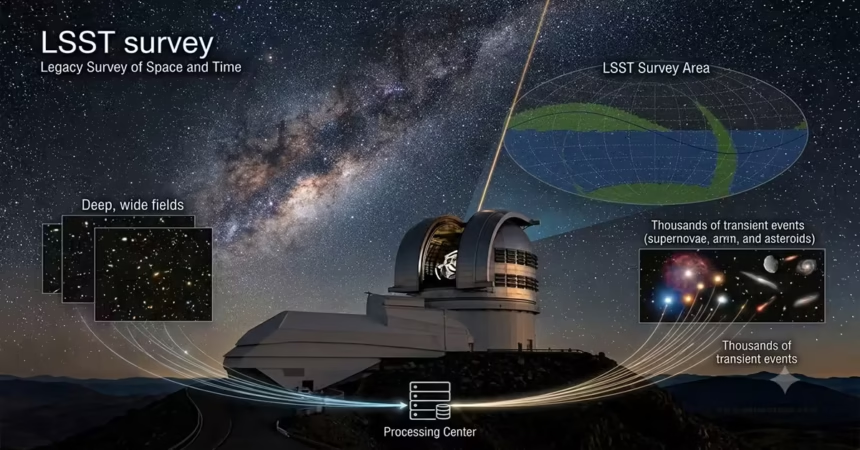
Vera C. Rubin Observatory LSST survey explained in plain terms is the most ambitious sky-mapping project ever attempted from the ground. The NSF–DOE Vera C. Rubin Observatory on Cerro Pachón in Chile officially started its ten-year Legacy Survey of Space and Time (LSST) on June 30, 2026. Every few nights the telescope sweeps the entire visible southern sky, building a deep, time-lapse movie of the cosmos that no previous facility could match.
Quick overview of what the survey actually does:
- Uses an 8.4-meter Simonyi Survey Telescope paired with the world’s largest digital camera (3.2 gigapixels).
- Images the southern sky roughly every 3–4 nights across six optical filters (ugrizy).
- Returns to each patch of sky about 800 times over a decade.
- Generates up to 10 million real-time alerts per night for anything that moves, brightens, or fades.
- Already delivered early wins, including thousands of new asteroids and the 2026 ED138 new dwarf planet beyond Pluto discovery during commissioning and pre-survey data.
This is not a static catalog. It is a continuous, high-cadence film of the changing universe.
The Hardware That Makes the LSST Possible
The telescope’s three-mirror design delivers a 9.6-square-degree field of view—about 45 times the area of the full Moon—while still delivering sharp images. The LSST Camera, assembled at SLAC, sits at the heart of the system. It takes a new exposure roughly every 40 seconds and can slew to the next field in just a few seconds.
That combination of aperture, field of view, and speed is called étendue. Rubin has more of it than any other optical survey telescope planned for this decade. The result is depth and breadth at the same time: single-visit images reach about magnitude 24 in the r-band, and the ten-year stacked images will push deeper still.
Four Science Pillars Driving the Survey
Astronomers designed the LSST around four overlapping goals.
- Dark energy and dark matter
Weak gravitational lensing and baryon acoustic oscillations measured across billions of galaxies will tighten constraints on the accelerated expansion of the universe. - Solar system inventory
The survey is already rewriting the census of asteroids, comets, and trans-Neptunian objects. Early data alone produced more than 11,000 previously unknown asteroids, including hundreds of distant icy bodies. The same capability delivered the 2026 ED138 new dwarf planet beyond Pluto discovery. - Transient and variable universe
Supernovae, kilonovae, tidal disruption events, and variable stars generate alerts within about a minute so other telescopes can follow up while the event is still fresh. - Milky Way structure
Mapping the stellar halo, streams, and faint satellite galaxies out to hundreds of kiloparsecs reveals how our galaxy assembled and tests models of dark matter on small scales.
One dataset serves all four. That efficiency is the real power of the design.
Survey Cadence and Data Flow in Practice
The baseline strategy is the Wide-Fast-Deep survey. Most of the southern sky receives uniform coverage. Five Deep Drilling Fields get roughly 30 times more visits for high-cadence studies of fast-evolving events.
Raw data volume runs 10–20 terabytes per night. Difference imaging against deep templates produces the alert stream almost immediately. Public data releases follow a staged schedule: early Data Previews, then annual Data Releases once the survey is fully underway.
In my experience watching large surveys ramp up, the first year is always the messiest and the most exciting. Systems get tuned in real time while science already flows. Rubin is following that pattern.
How the LSST Compares to Previous Surveys
| Feature | Rubin LSST | Typical Previous Wide Surveys (e.g., SDSS, DES) | Advantage |
|---|---|---|---|
| Field of view | 9.6 deg² | 1–3 deg² | Far larger area per exposure |
| Camera | 3.2 gigapixels | Hundreds of megapixels | Higher resolution + wider coverage |
| Revisit rate | Every 3–4 nights | Weeks to months | True time-domain science |
| Total visits per field | ~800 over 10 years | Dozens | Stacking depth + variability |
| Expected alerts per night | Up to 10 million | Thousands | Real-time discovery engine |
| Solar system yield | Millions of new orbits expected | Tens of thousands | Order-of-magnitude jump |
The difference is not incremental. It is a change in kind.
Step-by-Step Action Plan for Following the Survey
Anyone who wants to stay current can do it without special access.
- Bookmark the official Rubin Observatory news and survey-progress pages. Primary source first.
- Watch the alert brokers and community tools that filter the nightly stream for public use.
- Check the scheduled Data Preview and Data Release timelines—Data Preview 2 materials were already moving in late 2026.
- Follow the science collaborations (Dark Energy, Solar System, Transients, Milky Way) for early papers and press notes.
- Use interactive tools such as Orbitviewer when new solar-system objects appear; the same platform that showed the path of the 2026 ED138 new dwarf planet beyond Pluto discovery works for many other finds.
Do those five and you will stay ahead of most secondary coverage.
Common Mistakes People Make When Talking About the LSST
Mistake one: treating the survey as “just another telescope.” The combination of depth, area, and cadence is what changes the game.
Mistake two: assuming all science arrives only at the end of the decade. Early data and commissioning images already produced major results, including the dwarf-planet candidate.
Mistake three: underestimating the data volume. Processing and disseminating tens of terabytes nightly requires a global data system, not a single observatory server.
Fix them by reading the primary project documentation rather than simplified summaries.
Why This Survey Matters Right Now
The LSST is the first facility built from the ground up to treat the sky as a movie rather than a static photograph. Objects that move slowly, explode rarely, or vary subtly become visible only when you look often and deep. That is exactly how the 2026 ED138 new dwarf planet beyond Pluto discovery emerged from early Rubin data—hiding in a crowded star field until the right cadence and algorithms revealed it.
Over the next decade the same approach will deliver millions more solar-system orbits, hundreds of thousands of supernovae, and a map of the Milky Way’s faint outskirts that was previously impossible. Dark-energy constraints will tighten. Rare transients will be caught while they are still bright.
The survey is already running. The data are already flowing. The discoveries have already begun.
Key Takeaways
- The Vera C. Rubin Observatory LSST is a ten-year, high-cadence survey of the southern sky that began in late June 2026.
- An 8.4-meter telescope and 3.2-gigapixel camera deliver unmatched combination of area, depth, and speed.
- Four core science goals—dark energy/matter, solar system census, transients, and Milky Way structure—share the same dataset.
- Each sky patch receives roughly 800 visits, enabling both deep stacks and true time-domain science.
- Up to 10 million alerts can be issued each night.
- Early data already produced thousands of new asteroids and the 2026 ED138 new dwarf planet beyond Pluto discovery.
- Public data releases and alert streams make the survey accessible far beyond professional astronomers.
- The project is still in its first year; performance will continue to improve while science results keep arriving.
The practical next step is simple: follow the official survey progress pages and the first major Data Releases. That is where the real picture of what this survey can deliver will keep unfolding.
FAQs
When did the Vera C. Rubin Observatory LSST survey actually start?
The ten-year Legacy Survey of Space and Time formally began on June 30, 2026, after a period of commissioning and early operations optimization.
How often does the LSST image the same part of the sky?
Most of the southern sky is revisited every 3–4 nights on average, accumulating about 800 visits over the full decade.
Has the LSST already made significant discoveries?
Yes. Early and commissioning data yielded more than 11,000 new asteroids and the 2026 ED138 new dwarf planet beyond Pluto discovery, among other results.