2026 ED138 new dwarf planet beyond Pluto discovery hit the astronomy world this week like a quiet but unmistakable seismic event. Astronomers using the brand-new Vera C. Rubin Observatory in Chile have pulled a large, icy object out of the crowded star fields beyond Pluto. It’s provisionally designated 2026 ED138. Early size estimates put it between 600 and 1,500 kilometers across—big enough that its own gravity should have forced it into a roughly spherical shape. That single detail is why researchers are already calling it a strong dwarf planet candidate.
Here’s the quick rundown of why this matters right now:
- Rubin Observatory’s wide-field camera and rapid scanning caught the object moving against the dense Milky Way background where earlier surveys simply couldn’t.
- Current distance sits near 46 astronomical units—farther out than Pluto’s average 40 AU.
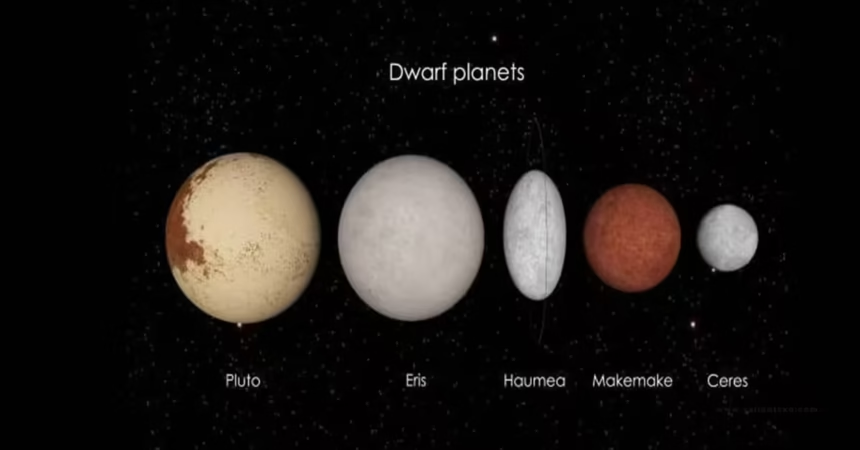
- If confirmed, it joins the short list of officially recognized dwarf planets: Pluto, Eris, Haumea, Makemake, and Ceres.
- The find came during commissioning and early survey data, not even the full ten-year Legacy Survey of Space and Time.
- Follow-up infrared observations over the next months will nail down the true size and surface properties.
This isn’t another faint speck. It’s one of the largest trans-Neptunian objects found in roughly two decades.
What Exactly Is the 2026 ED138 New Dwarf Planet Beyond Pluto Discovery?
Think of the Kuiper Belt and the scattered disk as a vast, dim attic. Most of the furniture up there is small and hard to see. Every so often someone opens a better window and spots something substantial that had been sitting in plain sight the whole time. That’s the story with 2026 ED138.
Matthew Holman of the Center for Astrophysics | Harvard & Smithsonian ran early 2026 Rubin data through a search algorithm he built with colleague Kevin Napier. On October 13 the code flagged an unusually bright, slow-moving object. Mario Jurić, Rubin’s solar system lead scientist at the University of Washington, then dug through the observatory’s catalogs and pulled another 20 detections stretching back to March. Archival images from the Dark Energy Camera pushed the observational arc all the way to 2016. Ten years of positions give a solid orbit.
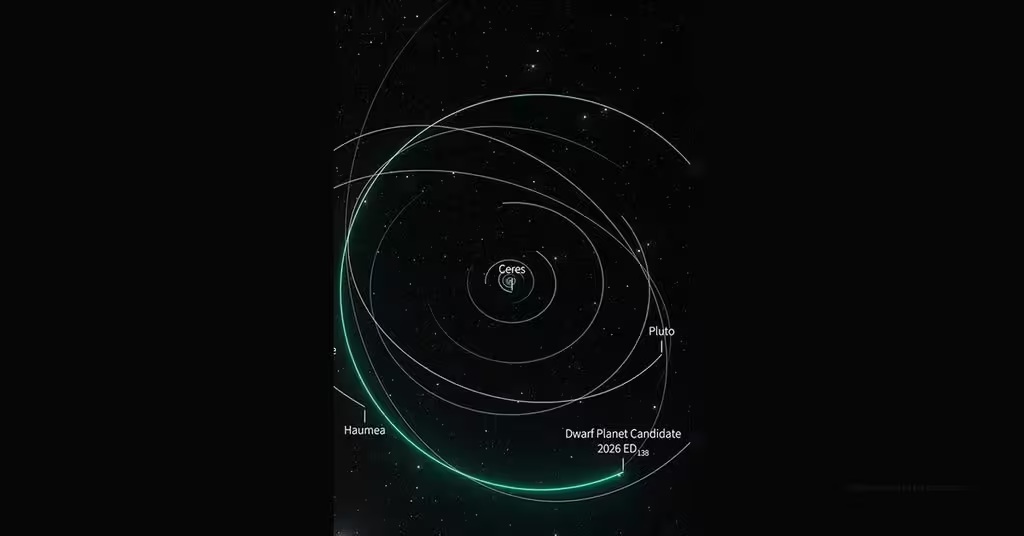
The object orbits the Sun every 281 years or so. Its path is tilted about 25 degrees relative to the plane of the planets—classifying it as a hot classical trans-Neptunian object. That tilt usually means Neptune’s gravity gave it a hard shove sometime in the distant past. Right now it sits near 46 AU. Perihelion is roughly 37 AU; aphelion reaches about 49 AU. In other words, its entire known path lies outside Neptune and mostly outside Pluto’s average distance.
Size is still a range because we only have reflected sunlight so far. Brightness plus distance plus an assumed range of surface reflectivity (albedo) produces the 600–1,500 km estimate. Anything above roughly 600 km made of ice is expected to be round. Roundness plus the inability to clear its orbital neighborhood of other debris is the working definition of a dwarf planet.
How the Vera C. Rubin Observatory Made the 2026 ED138 New Dwarf Planet Beyond Pluto Discovery Possible
Rubin’s Simonyi Survey Telescope is built for exactly this kind of work. It maps the entire southern sky every few nights with the largest digital camera ever constructed. The combination of depth, speed, and consistent cadence lets software spot slow movers that older, narrower surveys missed—especially in the galactic plane where background stars are dense enough to hide almost anything.
Earlier surveys simply didn’t revisit the same crowded fields often enough or with enough sensitivity. ED138 was there. We just lacked the right eyes and the right algorithms until now.
In my experience covering outer solar system discoveries, the first big find from a new facility almost always feels like an opening act. Rubin is still early in its ten-year run. The fact that it already turned up an object this substantial while the team was still commissioning the system tells you the attic is fuller than we thought.
Comparing 2026 ED138 to Known Dwarf Planets
Here’s a clean side-by-side of the current numbers. All figures for ED138 remain preliminary pending infrared follow-up.
| Object | Approx. Diameter (km) | Average Distance (AU) | Official Status | Notes |
|---|---|---|---|---|
| Pluto | 2,377 | 39.5 | Confirmed dwarf planet | Has five known moons |
| Eris | 2,326 | 67.7 | Confirmed | Slightly more massive than Pluto |
| Haumea | ~1,600 (elongated) | 43.1 | Confirmed | Fast rotator, two moons |
| Makemake | ~1,430 | 45.8 | Confirmed | Possible thin atmosphere |
| Ceres | 940 | 2.8 | Confirmed | Asteroid belt, not TNO |
| 2026 ED138 | 600–1,500 | ~46 (current) | Candidate | Needs size confirmation |
ED138 sits in interesting company. Even at the low end of its size range it would outrank Ceres. At the high end it approaches the smaller confirmed outer dwarf planets.
Step-by-Step Action Plan for Beginners Who Want to Follow the Story
You don’t need a research telescope to stay on top of this. Here’s the practical sequence I recommend to anyone who wants to track the confirmation process without drowning in noise.
- Bookmark the IAU Minor Planet Center circulars and the official Rubin Observatory news page. Those are the primary sources.
- Check Orbitviewer (the interactive tool linked from the Rubin release). You can rotate the solar system and watch ED138’s path relative to the known planets and dwarf planets in real time.
- Watch for infrared observations. NASA’s James Webb Space Telescope or ground-based infrared facilities will tighten the size and albedo numbers. Those results usually appear first in conference abstracts or short papers.
- Follow the Division for Planetary Sciences meeting updates and any subsequent AAS press briefings. Holman and Jurić already presented the initial findings; more will follow.
- Set a simple Google Alert for “2026 ED138” and “ED138 dwarf planet.” Ignore the speculative headlines that claim “sixth planet found” without the candidate qualifier.
Do those five things and you’ll stay ahead of the secondary reporting.
Common Mistakes & How to Fix Them When Reading About the 2026 ED138 New Dwarf Planet Beyond Pluto Discovery
People keep tripping over the same three points.
Mistake one: calling it a planet. It isn’t. Even if confirmed as a dwarf planet it will never clear its neighborhood the way the eight major planets do. The distinction is real and useful.
Mistake two: treating the 600–1,500 km range as a settled measurement. It’s an estimate based on visible light. Dark surfaces look smaller; bright ones look larger. Infrared data will shrink that uncertainty.
Mistake three: assuming the discovery means the outer solar system is suddenly complete. The opposite is true. Rubin is just getting started. Expect more candidates, some of them possibly larger, over the next several years.
Fix all three by reading the primary releases from the NSF–DOE Vera C. Rubin Observatory and the IAU Minor Planet Center rather than the breathless secondary coverage.
Why This Discovery Changes the Map
Every new large trans-Neptunian object tightens our picture of how the giant planets migrated early in solar system history. The 25-degree tilt on ED138’s orbit is a fossil record of that chaos. Objects this size also help calibrate the overall mass budget of the Kuiper Belt and scattered disk. In practical terms, more mass out there means stronger constraints on models of planet formation and the early dynamical environment.
The kicker is how ordinary the find feels once you absorb the technology. A brand-new survey telescope, still in its first year of serious data, reaches into a crowded star field and pulls out a world that has been circling the Sun for billions of years. That should recalibrate everyone’s expectations for what else is still waiting.
Key Takeaways
- 2026 ED138 is a newly identified dwarf planet candidate orbiting beyond Pluto at roughly 46 AU.
- Size estimates range from 600 to 1,500 km; infrared data will refine the number.
- The object was found in early Vera C. Rubin Observatory data by Matthew Holman and confirmed with archival observations stretching back a decade.
- Its orbit is inclined about 25 degrees and takes roughly 281 years to complete.
- If confirmed, it becomes the sixth recognized dwarf planet after Pluto, Eris, Haumea, Makemake, and Ceres.
- Rubin’s wide-field, rapid-cadence approach is uniquely suited to finding more such objects.
- Follow-up observations over the coming months will determine whether the candidate graduates to official status.
- The discovery is early evidence that the full Legacy Survey of Space and Time will rewrite the inventory of the outer solar system.
The next clear step is simple: watch the infrared results. Those numbers will decide whether 2026 ED138 stays a candidate or takes its place on the short official list. Until then, treat it as what it is—an impressive new neighbor that reminds us how much of our own solar system we still haven’t properly catalogued.
FAQs
Is the 2026 ED138 new dwarf planet beyond Pluto discovery already confirmed?
No. It is a strong candidate based on size estimates and orbital data. Official dwarf-planet status requires tighter constraints on diameter and shape, which infrared observations will provide in the coming months.
How far away is 2026 ED138 right now?
Approximately 46 astronomical units from the Sun—farther than Pluto’s current average distance of about 40 AU.
Can amateur astronomers see the 2026 ED138 new dwarf planet beyond Pluto discovery?
Skilled amateurs with large telescopes and precise coordinates can detect it under good conditions. It is not visible to the naked eye or with small backyard instruments.