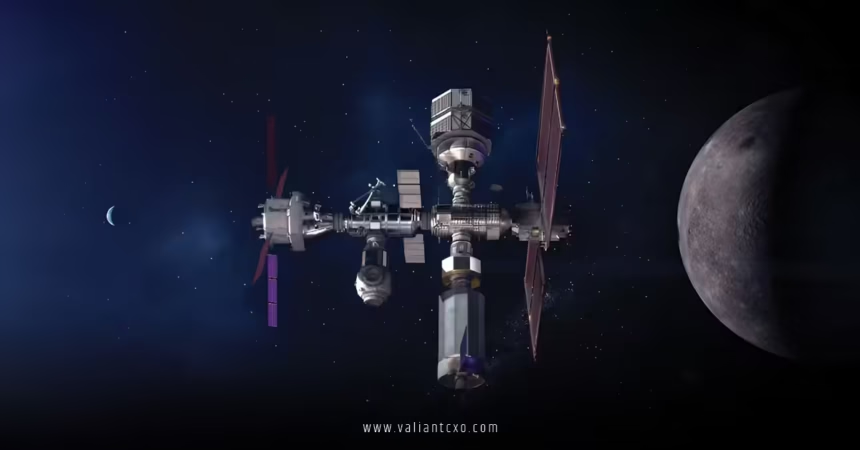
The Artemis program lunar gateway station represents NASA’s blueprint for sustained human presence on and around the Moon. Unlike Apollo’s brief visits, this orbiting outpost will serve as a refueling depot, crew quarters, and science hub—essentially a space station for lunar operations. Think of it as the difference between a gas station and a rest stop on a road trip: you need infrastructure that lets you stay awhile and resupply.
Quick Overview: What You Need to Know
Here’s the essential picture of the lunar gateway:
- Core function: An orbiting way station in lunar space (not on the surface) that supports crewed and robotic lunar missions
- Orbit type: Near-rectilinear halo orbit (NRHO) around the Moon, roughly 1,000 km from the lunar surface at closest approach
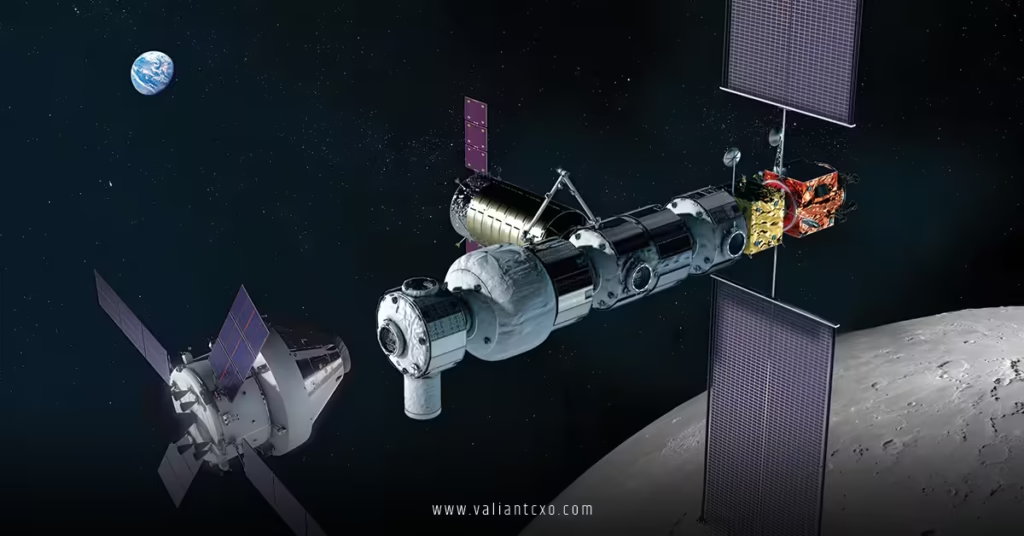
- Primary modules: Power & Propulsion Element (PPE), Habitation and Logistics Outpost (HALO), and additional science/cargo modules launching over time
- Crew capacity: Supports 4-6 astronauts for extended stays, with visits ranging from weeks to months
- Launch timeline: Initial modules launching between 2026-2028, with full operational capability by late 2020s
- Why it matters: Enables frequent crewed missions, reduces reliance on Earth-launched supplies, and serves as the staging point for Reid Wiseman Artemis III mission updates 2026 and beyond
The Problem It Solves: Why We Need a Lunar Gateway
Here’s the fundamental challenge: the Moon is far away. Even with modern rockets, the journey takes three days each way. If you want to support multiple crewed missions, you can’t keep launching everything from Earth. It’s expensive, logistically complex, and inefficient.
The lunar gateway solves this by creating a persistent outpost in lunar orbit. Instead of sending a complete life support and habitat system for every mission, you establish infrastructure that stays put. Crews arrive, dock, and depart. Equipment gets cached there. Fuel gets stockpiled. It’s the difference between commuting to work every single day versus having a home base you return to.
Without the gateway, Artemis III and subsequent missions would need to be one-and-done operations—land, collect samples, go home. With it, you can stage longer surface operations, land multiple crews, establish a surface base camp, and eventually build toward a permanent lunar presence.
Artemis Program Lunar Gateway Station Architecture
The gateway isn’t a single module launched all at once. It’s a modular architecture that grows over time, with different components added as they’re completed and certified.
Core Modules and Their Functions
Power & Propulsion Element (PPE)
This is the backbone. The PPE provides electrical power (via solar arrays), maintains the gateway’s orbit, and enables maneuvering for rendezvous operations. Think of it as the engine and generator for the entire facility.
The PPE uses solar electric propulsion—ion thrusters that are incredibly efficient for long-term orbital maintenance. This is different from traditional chemical thrusters; ion propulsion sips fuel while delivering steady, consistent thrust over months or years.
Habitation and Logistics Outpost (HALO)
HALO is where crews live and work during their stay. It provides life support systems, sleeping quarters, exercise equipment, and storage for supplies and experiments. The module is approximately 12 meters long and contains enough volume for a small team to live comfortably for extended periods.
HALO also serves as the docking hub. Multiple vehicles (Orion spacecraft, cargo vehicles, rovers) will dock to HALO’s ports, making it the central meeting point for all gateway operations.
International Gateway Modules
ESA (European Space Agency), JAXA (Japan), and Canadian Space Agency (CSA) are contributing additional modules. ESA is developing the International Habitation Module (I-Hab), while others are supplying robotic arms, airlocks, and specialized equipment. This distributed approach spreads development costs and brings international expertise to the table.
The Orbital Position: Near-Rectilinear Halo Orbit
The gateway orbits the Moon in a near-rectilinear halo orbit (NRHO). This isn’t a traditional circular orbit—it’s a more complex trajectory that takes advantage of orbital mechanics.
Here’s why NRHO matters:
| Aspect | NRHO Advantage | Why It Matters |
|---|---|---|
| Fuel efficiency | Requires minimal station-keeping propellant | Reduces operational costs long-term |
| Sun exposure | Maintains near-constant solar illumination | Enables continuous solar power generation |
| Lunar access | Allows quick descent to lunar south pole | Reduces travel time to landing sites |
| Stability | Naturally stable with minimal intervention | Decreases active attitude control burden |
| Communications | Line-of-sight with Earth and lunar surface | No blind spots for data relay |
The NRHO isn’t circular—it sweeps out a large, elongated loop around the Moon, with the gateway’s distance varying significantly. At perilune (closest point), it’s about 1,000 km above the Moon. At apilune (farthest point), it’s roughly 70,000 km away. This eccentric trajectory is actually a feature, not a bug, because it creates the fuel efficiency and orbital stability engineers need.
Timeline: When Does the Lunar Gateway Actually Become Operational?
Timelines in spaceflight are fluid, but here’s the current plan for gateway assembly:
2026-2027: Core Module Launch
The Power & Propulsion Element (PPE) and Habitation and Logistics Outpost (HALO) launch during this window. PPE launches first on a commercial heavy-lift rocket (likely SpaceX Falcon Heavy or similar), entering the NRHO uncrewed. HALO follows on an SLS rocket carrying additional cargo and arriving with its own propulsion for final rendezvous and docking.
These two modules establish the minimum viable gateway—enough power and life support for initial operations.
2027-2028: International Module Arrivals
ESA’s I-Hab module launches, expanding habitable volume and adding European laboratory capabilities. Additional logistics modules and cargo vehicles arrive, stocking supplies for extended operations. The Canadian Robotic Arm (an upgraded version of the ISS arm) arrives to support external operations.
2028+: Full Operational Capability
By late 2028 or 2029, the gateway reaches full operational status with all core modules in place and integrated. At this point, it can support simultaneous crewed visits, long-duration stays, and complex surface operations. Artemis program lunar gateway station infrastructure is ready for the high-tempo mission cadence NASA envisions.
How Artemis III Connects to Gateway Operations
Here’s where the broader mission architecture comes into focus. Reid Wiseman Artemis III mission updates 2026 describe the first crewed lunar landing, but the gateway plays an evolving role in that timeline.
For Artemis III, the gateway may still be in early assembly phases. Early versions of the mission profile show Orion crews staging directly from Earth orbit to the lunar surface via the Human Landing System. But as gateway modules come online, subsequent Artemis missions (IV, V, VI and beyond) will use it as a hub.
By Artemis IV and V, crews will dock at the gateway, resupply, conduct orbital science, and then depart for surface missions. This creates a rhythm: arrive at gateway, prepare, descend to Moon, ascend back to gateway, depart for Earth. It’s more efficient, safer (because you have redundant systems at the gateway), and enables longer surface stays.
The gateway also serves as a data relay and communications hub. Surface crews can maintain constant contact with Earth through gateway-based relay systems, even in regions that don’t have direct line-of-sight to Earth.
Operational Logistics: How Crews and Cargo Get There
The gateway isn’t self-sufficient from day one. Resupply missions are built into the operational model.
Crewed Transportation
Orion spacecraft, carrying four crew members, launch from Earth and rendezvous with the gateway. Crews dock, transfer payload and supplies, conduct their operations (whether that’s gateway maintenance, orbital science, or preparation for descent to the Moon), and eventually return to Earth.
Turnaround time from Earth arrival to gateway dock is typically 2-3 days. Once docked, crews have flexibility—they can stay for weeks, conducting multiple surface sorties via the Human Landing System (HLS).
Cargo and Resupply
Robotic cargo vehicles deliver supplies without crew. These include consumables (food, water, oxygen), replacement equipment, scientific instruments, and fuel. Commercial vendors and international partners supply these vehicles.
SpaceX’s Dragon XL (an expanded cargo version of Dragon) is one vendor. Others include Cygnus (Northrop Grumman) and European cargo vehicles. Having multiple vendors ensures competition, redundancy, and reliable logistics.
In-Situ Resource Utilization (ISRU) Connection
Down the line, the gateway will connect to lunar surface resources. Water ice extracted from the Moon can be processed into fuel and oxygen. If that ISRU capability comes online (currently in the research phase), it could dramatically reduce the need for Earth-launched supplies. Imagine producing rocket propellant on the Moon and fueling spacecraft at the gateway—that changes the economics completely.
Scientific Capabilities: What Research Happens at the Gateway
The gateway isn’t just a logistics hub. It’s a genuine laboratory for deep-space science.
Astronomy and Astrophysics
Unlike Earth-orbiting telescopes, a lunar gateway telescope enjoys minimal Earth interference. The far side of the Moon shields it from Earth’s radio noise. Instruments based at or near the gateway could observe the early universe with unprecedented clarity. Some mission concepts include telescope modules that dock temporarily at the gateway.
Lunar and Planetary Science
The gateway serves as a research platform for studying the Moon from orbit. High-resolution imaging, spectroscopy, and other remote sensing instruments can map resources, identify future landing sites, and conduct scientific surveys. This data directly informs where surface missions go next.
Radiation and Human Physiology
Long-duration crews at the gateway provide data on how humans respond to deep-space radiation and microgravity over extended periods. This research is critical for eventual Mars missions, where crews will spend 6-9 months in transit. Understanding how to mitigate radiation and preserve muscle and bone density directly applies to those longer voyages.
Technology Demonstration
The gateway is a testbed for technologies needed for deeper space exploration. Advanced life support systems, radiation shielding, power systems, and autonomous operations all get validated in this environment before being deployed further.
International Collaboration: Why This Is a Team Effort
The lunar gateway is genuinely international. This isn’t NASA doing it alone.
| Partner | Contribution | Strategic Value |
|---|---|---|
| ESA (Europe) | I-Hab module, Orion Service Module | European capabilities in life support and propulsion |
| JAXA (Japan) | Pressurized logistics modules, experiments | Asian partnership and supply chain diversity |
| CSA (Canada) | Robotic arm, maintenance systems | Proven track record on ISS, robotics expertise |
| Commercial Partners | Cargo vehicles, resupply services | Competition drives innovation and cost reduction |
| Emerging Partners | Various contributions TBD | Potential involvement from other nations |
This distributed approach has real advantages. It reduces the financial burden on any single agency. It leverages expertise from different organizations. It builds political will across multiple nations—when many countries invest in a project, they all benefit from success.
From a diplomatic perspective, the gateway is a symbol that space exploration works best when nations cooperate rather than compete. That message matters.
Common Mistakes People Make About the Lunar Gateway
Mistake 1: Confusing the gateway with a lunar surface base
Reality: The gateway orbits the Moon; it’s not on the surface. It’s a staging point for surface operations, not a replacement for them. You still need landers to get to the actual Moon.
Mistake 2: Thinking it’s redundant with the ISS
Reality: The ISS and gateway serve completely different purposes. The ISS studies Earth and low Earth orbit. The gateway enables deep-space exploration. They’re complementary, not competitive.
Mistake 3: Underestimating the engineering complexity
Reality: Building and maintaining a space station 240,000 miles away is genuinely hard. Every component must be ultra-reliable because you can’t send a repair crew tomorrow. Redundancy, testing, and conservative design drive everything.
Mistake 4: Assuming it’s only for science
Reality: The gateway is primarily an operational hub. Science happens, but the core mission is enabling frequent, sustainable lunar access. Think infrastructure first, science second.
Mistake 5: Overlooking the long-term cost implications
Reality: Launching modules, resupplying crews, and maintaining systems costs serious money annually. Budget pressures could stretch timelines or reduce functionality. Managing cost is an ongoing challenge.
Step-by-Step: What Gateway Operations Look Like
Here’s how a typical mission sequence plays out once the gateway is fully operational:
Pre-Mission (Weeks Before)
- Cargo vehicles launch from Earth carrying supplies and equipment
- Gateway operations team confirms modules are ready and healthy
- Orion spacecraft undergoes final launch preparations
- Crew completes final training and medical clearance
Launch Through Gateway Arrival
- Orion launches from Kennedy Space Center
- Crew performs standard orbital checkout over first day
- Trans-lunar injection burn accelerates Orion toward the Moon
- 2-3 day coast to the Moon
- Lunar orbit insertion burn
- Rendezvous with gateway in NRHO
- Docking to HALO module (approximately 6-7 days after launch)
Gateway Operations Phase
- Crew enters gateway, confirms life support and systems nominal
- Unload cargo and supplies from Orion
- Perform maintenance, upgrades, or reconfiguration as needed
- If lunar surface missions planned: descend to Moon via HLS, conduct surface operations, return to gateway
- Conduct orbital science, maintenance, or experiments
- Prepare for return to Earth
Return to Earth
- Crew departs gateway and returns to Orion
- Undocking from gateway
- Trans-Earth injection burn
- 2-3 day coast to Earth
- Atmospheric entry and splashdown
The beauty of this architecture: once the gateway is operational, the rhythm repeats. Missions become routine rather than one-off spectaculars.
Key Takeaways
- Artemis program lunar gateway station is an orbiting way station in lunar orbit designed to support sustained human exploration
- The gateway uses a near-rectilinear halo orbit (NRHO), which provides fuel efficiency, constant solar power, and access to the lunar south pole
- Core modules (PPE and HALO) launch 2026-2027, with full operational capability achieved by late 2028 or 2029
- International partners (ESA, JAXA, CSA, commercial vendors) contribute modules and resupply services, making this a genuinely collaborative effort
- The gateway enables multiple crewed missions to the lunar surface without launching complete life support systems for each
- Reid Wiseman Artemis III mission updates 2026 may precede full gateway activation, but subsequent Artemis missions will heavily utilize the gateway as infrastructure matures
- Scientific research at the gateway includes astronomy, planetary science, radiation studies, and technology demonstrations for future Mars missions
- Operational logistics rely on robotic resupply vehicles and crewed rotations, creating a sustainable cadence rather than episodic visits
- The gateway transforms lunar exploration from a destination mission mentality to a sustained presence model
- Cost, reliability, and international coordination are the three biggest operational challenges ahead
Conclusion
The Artemis program lunar gateway station transforms how we think about lunar exploration. It’s the difference between visiting and staying, between one mission and a sustained presence. By establishing infrastructure in lunar orbit, NASA and its international partners are building the foundation for decades of human activity on the Moon.
The gateway connects directly to broader Artemis objectives: supporting Reid Wiseman Artemis III mission updates 2026 and subsequent surface missions, enabling long-duration stays, supporting scientific research, and ultimately creating the stepping stone to Mars.
Timelines will shift. Costs may adjust. Technical challenges will emerge. But the core concept—that you can’t sustain deep-space exploration without persistent infrastructure—is solid. The gateway is that infrastructure. It’s expensive to build, complex to operate, and absolutely necessary for what comes next.
The Moon isn’t just a destination anymore. It’s becoming a place where humans work, learn, and build for the future.
External References:
- NASA’s Lunar Gateway program overview: NASA’s Gateway to the Moon page — Official specifications, module descriptions, and mission architecture details from the source.
- ESA’s contribution to the lunar gateway: ESA Artemis and Gateway information — International partnership details and European module specifications for the I-Hab and other contributions.
- JAXA’s lunar exploration partnerships: JAXA Artemis Program Resources — Information on Japanese partnerships, logistics modules, and scientific instruments contributing to gateway operations.
Frequently Asked Questions
Q: How does the Artemis program lunar gateway station differ from the International Space Station?
A: The ISS orbits Earth at 400 km altitude and focuses on Earth-based research, materials science, and life sciences in low Earth orbit. The gateway orbits the Moon in deep space and serves primarily as a logistics and staging hub for lunar surface missions. They’re both space stations but operate in completely different environments with different purposes.
Q: What happens if a module fails at the gateway?
A: The gateway is designed with redundancy. If one component fails, backup systems take over. For non-critical failures, repair crews arrive on the next resupply mission. For critical systems, the module can be isolated and a replacement launched. Failure isn’t catastrophic because the architecture expects it and plans around it.
Q: Will Reid Wiseman Artemis III mission updates 2026 include gateway operations?
A: Artemis III is planned primarily as a direct Earth-to-Moon-to-Earth mission. However, early gateway modules may already be in NRHO by that time. Subsequent Artemis missions (IV, V, and beyond) will use the gateway as a central hub for more frequent and extended lunar operations.
Q: How much crew time will be spent at the gateway versus on the lunar surface?
A: Early missions will spend more time on the surface. As the gateway becomes fully operational, crews might spend 1-2 weeks at the gateway for every week on the surface. The gateway becomes a base camp for orchestrating surface operations rather than a destination itself.
Q: Can the gateway be resupplied indefinitely, or does it need replacement?
A: Spacecraft and equipment degrade over time. Components have design lifespans. The gateway can be resupplied indefinitely (in theory), but major modules or systems will eventually need replacement. Planning for component lifecycle management is built into the operational model. This is similar to how the ISS receives periodic upgrades and component replacements.
Q: What’s the total cost of building and operating the lunar gateway?
A: Estimates vary widely, from $30-60 billion over the life of the program, depending on how you count international contributions and how long the gateway operates. It’s expensive, but spread over multiple agencies and years, the annual cost is manageable. The ISS cost significantly more when you account for decades of operation.