Royal air force support to NATO air policing represents one of Britain’s most sustained and strategically important military commitments to collective European defense. Since NATO’s air policing mission began in 2004, the RAF has deployed thousands of personnel and advanced fighter aircraft to protect the airspace of Baltic states and other allies who lack sufficient air defense capabilities.
Here’s what makes this mission so crucial:
- Continuous Protection: RAF Typhoon fighters provide 24/7 air surveillance and interception capabilities for NATO’s most vulnerable members
- Deterrent Effect: British presence signals unwavering commitment to Article 5 collective defense
- Rapid Response: RAF jets can scramble within minutes to intercept unidentified aircraft
- Training Value: Pilots gain invaluable experience operating in diverse European airspace
- Alliance Solidarity: Demonstrates UK leadership in burden-sharing despite Brexit
What Is NATO Air Policing and Why Does It Matter?
Think of NATO air policing like neighborhood watch—but with supersonic jets.
Some NATO members simply don’t have the military infrastructure to monitor and defend their own skies. Estonia, Latvia, and Lithuania, for example, have no fighter jets of their own. Iceland has no military at all. Without air policing, these nations would be sitting ducks.
That’s where the RAF steps in.
The Mission Scope
NATO air policing isn’t about combat—it’s about presence and deterrence. RAF pilots patrol designated airspace, identify unknown aircraft, and escort them away if necessary. Most intercepts involve civilian planes that have strayed off course or lost radio contact.
But the real purpose? Sending a clear message that NATO airspace is monitored, protected, and defended.
How Royal Air Force Support to NATO Air Policing Actually Works
The RAF’s contribution operates through a rotational deployment system that’s both flexible and predictable.
Deployment Structure
Primary Bases: RAF Typhoons typically deploy to:
- Šiauliai Air Base (Lithuania)
- Ämari Air Base (Estonia)
- Keflavík Air Base (Iceland)
Rotation Schedule: Deployments last 4-6 months, with approximately 100-150 RAF personnel per rotation.
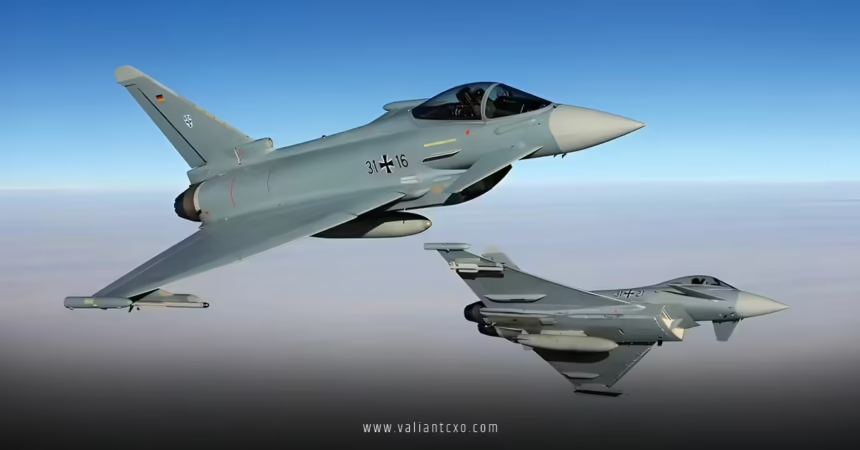
Aircraft: Usually 4-6 Eurofighter Typhoon jets per deployment, equipped for air-to-air combat and reconnaissance.
Daily Operations
Here’s what a typical day looks like:
- Alert Status: Two aircraft maintained on Quick Reaction Alert (QRA) at all times
- Scramble Capability: RAF pilots can be airborne within 15 minutes of receiving orders
- Patrol Flights: Regular training sorties double as deterrent presence
- Coordination: Constant communication with NATO Combined Air Operations Centre
The whole system runs like clockwork. Has to—when you’re protecting millions of people’s airspace, there’s no room for amateur hour.
The Strategic Importance of RAF Participation
Royal air force support to NATO air policing delivers benefits that extend far beyond the immediate tactical mission.
Political Signaling
Every RAF Typhoon over Baltic skies sends a diplomatic message. Post-Brexit Britain remains committed to European security. The UK won’t retreat into isolationism despite leaving the EU.
Military Readiness
RAF pilots gain operational experience they simply can’t get at home. Flying in different airspace, coordinating with foreign air traffic control, operating from unfamiliar bases—these challenges sharpen skills and build confidence.
Alliance Burden-Sharing
According to NATO’s official documentation, the air policing mission costs approximately €100 million annually across all participating nations. The RAF’s contribution represents roughly 15-20% of that total—a significant investment in collective security.
Intelligence Gathering
RAF aircraft regularly encounter Russian military flights testing NATO response times. These intercepts provide valuable intelligence about Russian capabilities, tactics, and intentions.
Key Challenges and How the RAF Overcomes Them
No mission this complex runs without obstacles. The RAF has learned to navigate several recurring challenges.
| Challenge | RAF Solution |
|---|---|
| Weather Extremes | Cold weather training, specialized equipment packages |
| Language Barriers | Standardized NATO procedures, interpreter support |
| Logistics Complexity | Forward-deployed maintenance teams, robust supply chains |
| Pilot Fatigue | Strict rotation schedules, crew rest requirements |
| Equipment Wear | Increased maintenance intervals, spare parts stockpiling |
Geographic Complications
Baltic airspace presents unique challenges. Narrow corridors, busy civilian traffic, and proximity to Russian territory require split-second decision-making. RAF pilots train extensively for these scenarios before deployment.
Technical Integration
RAF Typhoons must integrate seamlessly with NATO command systems, foreign radar networks, and allied aircraft from other nations. The technical complexity is staggering—and the RAF handles it routinely.
Step-by-Step: How RAF Deployments Are Planned and Executed
Want to understand how royal air force support to NATO air policing actually happens? Here’s the behind-the-scenes process:
Phase 1: Strategic Planning (6-12 months prior)
- NATO identifies air policing requirements
- RAF commits to specific deployment windows
- Personnel selection and pre-deployment training begins
- Equipment and logistics planning commences
Phase 2: Pre-Deployment Preparation (3-6 months)
- Selected pilots complete specialized training programs
- Aircraft undergo comprehensive maintenance checks
- Support personnel receive briefings on local procedures
- Advance teams conduct site surveys at deployment bases
Phase 3: Deployment Execution (1-2 weeks)
- Aircraft ferry flights to deployment base
- Personnel transport and accommodation setup
- Systems integration testing and validation
- Handover from previous NATO partner
Phase 4: Operational Phase (4-6 months)
- 24/7 Quick Reaction Alert status maintained
- Regular training flights and proficiency exercises
- Real-world scrambles and intercepts as required
- Continuous coordination with NATO command structure
Phase 5: Redeployment and Handover
- Mission handover to successor NATO ally
- Aircraft and personnel return to UK
- After-action reports and lessons learned capture
- Equipment maintenance and reset for future deployments
Common Mistakes in Understanding Air Policing (And the Truth)
Mistake #1: “Air policing is just practice flights” Reality: These are real operations with genuine strategic importance. RAF pilots have intercepted dozens of unidentified aircraft, including military flights testing NATO boundaries.
Mistake #2: “Only small countries need air policing” Reality: Even major NATO allies like Germany and Italy have hosted air policing missions during aircraft upgrades or maintenance periods.
Mistake #3: “It’s too expensive for the benefits” Reality: The cost per protected citizen works out to roughly €0.20 per year—less than a cup of coffee for year-round air defense.
Mistake #4: “RAF participation doesn’t matter post-Brexit” Reality: Military cooperation exists separately from EU membership. NATO commitments remain unchanged.
Mistake #5: “Modern threats make air policing obsolete” Reality: Hybrid warfare makes traditional air policing more important, not less. Controlling airspace remains fundamental to sovereignty.
Future Evolution of Royal Air Force Support to NATO Air Policing
The mission continues evolving to meet new challenges and threats.
Technological Upgrades
RAF Typhoons are receiving advanced radar systems and electronic warfare capabilities to counter increasingly sophisticated threats. Future deployments may include unmanned systems working alongside manned fighters.
Expanded Geographic Scope
NATO is considering extended air policing coverage for Romania, Bulgaria, and other eastern members. The RAF stands ready to expand its commitment if required.
Enhanced Integration
Deeper coordination with cyber defense, space surveillance, and electronic warfare represents the future of air policing. The RAF is positioning itself at the forefront of these developments.
Key Takeaways
- Sustained Commitment: The RAF has maintained continuous air policing deployments for over two decades
- Strategic Value: The mission delivers political, military, and intelligence benefits far exceeding its costs
- Operational Excellence: RAF pilots and support personnel have consistently exceeded NATO performance standards
- Alliance Leadership: British participation demonstrates continued commitment to collective European security
- Future Ready: The RAF is adapting air policing capabilities to meet emerging 21st-century threats
- Cost Effective: The investment represents exceptional value for money in terms of security delivered
- Training Benefits: Deployments provide invaluable operational experience for RAF personnel
Action Plan: What This Means for Defense Policy
Understanding royal air force support to NATO air policing matters whether you’re a policy analyst, military professional, or informed citizen.
For Defense Professionals: Study the logistics and coordination models—they represent best practices in multinational military cooperation.
For Policy Analysts: Consider the cost-benefit analysis when evaluating other alliance commitments and burden-sharing arrangements.
For Citizens: Recognize that air policing represents excellent value for defense spending—protecting allies while training our own forces.
The bottom line? This mission works. It protects vulnerable allies, strengthens NATO solidarity, and keeps RAF pilots sharp. In an increasingly uncertain world, that combination of benefits makes royal air force support to NATO air policing a strategic winner.
Conclusion
Royal air force support to NATO air policing exemplifies smart defense policy in action. By protecting allied airspace, the RAF strengthens the entire alliance while gaining invaluable operational experience. The mission costs relatively little but delivers enormous strategic value—exactly the kind of commitment Britain should be making in today’s security environment.
The future will bring new challenges, from hybrid threats to cyber warfare. But the fundamental principle remains unchanged: collective defense works when allies step up and contribute their best capabilities.
The RAF’s air policing commitment does exactly that.
Frequently Asked Questions
Q: How does royal air force support to NATO air policing differ from combat missions?
A: Air policing focuses on surveillance, identification, and peaceful interception rather than combat operations. RAF pilots carry weapons for self-defense but use diplomatic protocols to resolve most encounters.
Q: What happens when RAF jets intercept Russian aircraft?
A: Standard procedures involve visual identification, radio contact attempts, and escorting the aircraft away from protected airspace. Most encounters remain professional and peaceful.
Q: How many RAF personnel deploy for each air policing rotation?
A: Typical deployments include 100-150 personnel: pilots, maintenance crews, air traffic controllers, intelligence specialists, and support staff.
Q: Do RAF pilots face language barriers during NATO air policing missions?
A: NATO uses standardized English for all aviation communications, though cultural briefings help RAF personnel integrate with local communities at deployment bases.
Q: What aircraft does the RAF use for air policing compared to other NATO allies?
A: The RAF primarily deploys Eurofighter Typhoons, while other nations use F-16s, F-35s, or Saab Gripens. All aircraft meet NATO interoperability standards for effective coordination.