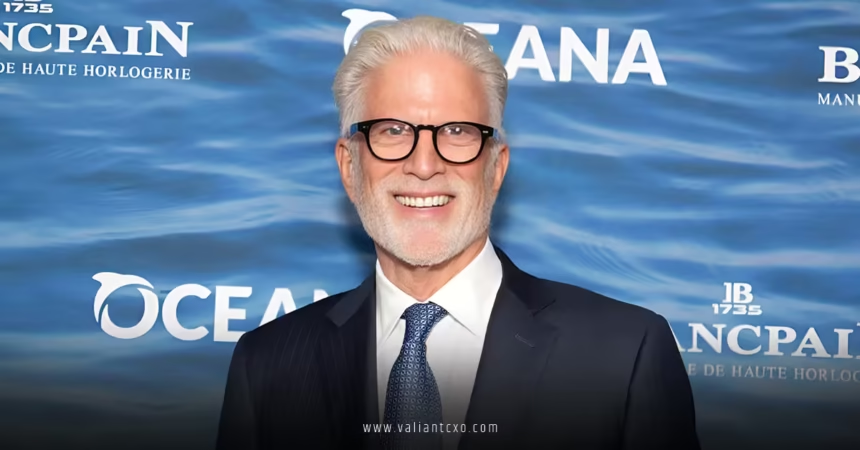
Ted Danson environmental activism ocean conservation represents one of Hollywood’s most enduring and impactful celebrity environmental commitments. The Emmy-winning actor, best known for his role as Sam Malone in Cheers, has spent over three decades fighting to protect our oceans with the same dedication he brought to perfecting his craft on screen.
What Makes Ted Danson’s Ocean Activism Stand Out
Here’s what sets Danson apart in the crowded field of celebrity environmentalism:
- Long-term commitment: Over 30 years of consistent ocean advocacy, not just a publicity phase
- Scientific backing: Co-founded the American Oceans Campaign (now Oceana) with marine biologists and policy experts
- Policy focus: Actively lobbies Congress and testifies before committees on ocean protection legislation
- Educational outreach: Uses his platform to translate complex marine science into accessible public messaging
- Financial investment: Has donated millions of his own money to ocean conservation causes
The Genesis of a Marine Advocate
Danson’s environmental awakening didn’t happen overnight.
In the late 1980s, while living in Santa Monica, he witnessed firsthand the environmental destruction along California’s coastline. Oil spills, plastic pollution, and dying marine life became impossible to ignore. The kicker? His daughters started asking him tough questions about what kind of world he was leaving them.
That’s when everything clicked.
Instead of writing a check and calling it good, Danson dove deep into marine science. He educated himself on ocean ecosystems, climate change impacts, and the intricate web of policies governing our seas. This wasn’t celebrity virtue signaling—this was a man on a mission.
Building Oceana: More Than Just Another Nonprofit
The Strategic Foundation
In 2001, Danson co-founded Oceana, which has become the largest international organization dedicated solely to ocean conservation. Here’s why Oceana works where other environmental groups struggle:
| Traditional Approach | Oceana’s Method |
|---|---|
| Broad environmental focus | Ocean-only specialization |
| Awareness campaigns | Policy-driven solutions |
| Grassroots organizing | Strategic litigation |
| Long-term goals | Measurable, time-bound victories |
Measurable Impact Under Danson’s Leadership
Oceana has racked up impressive wins with Danson as board chair:
- Protected 4 million square miles of ocean habitat through policy victories
- Banned bottom trawling in sensitive areas along the U.S. West Coast
- Secured fishing quotas that have helped rebuild depleted fish populations
- Eliminated destructive practices like shark finning in multiple countries
- Reduced plastic pollution through single-use plastic bans in coastal communities
Ted Danson’s Hands-On Approach to Ocean Conservation
Congressional Testimony and Policy Work
Danson regularly appears before Congress, armed with scientific data and compelling storytelling. His 2019 testimony on offshore drilling drew national attention when he challenged senators with hard facts about economic impacts on coastal communities.
The man does his homework. Seriously.
Educational Initiatives
Through Oceana’s campaigns, Danson has helped launch educational programs reaching millions of Americans. His approach? Make ocean science accessible without dumbing it down.
Key educational focuses include:
- Climate change impacts on marine ecosystems
- The connection between healthy oceans and food security
- Economic benefits of sustainable fishing practices
- How individual actions aggregate into meaningful change
Corporate Partnerships and Pressure
Danson leverages his Hollywood connections to pressure corporations into adopting ocean-friendly practices. He’s worked with major retailers to eliminate single-use plastics and pushed fishing companies toward sustainable methods.
The Science Behind Danson’s Activism
Understanding Ocean Acidification
One of Danson’s primary focuses involves ocean acidification—often called “the other CO2 problem.” As oceans absorb excess atmospheric carbon dioxide, they become more acidic, threatening shell-forming creatures and entire food chains.
Danson explains complex science like this: “Imagine trying to build your house while someone keeps dissolving your foundation. That’s what acidification does to marine life.”
Addressing Overfishing and Dead Zones
Working with marine biologists, Danson has highlighted how industrial fishing practices create ocean dead zones—areas where oxygen levels drop so low that marine life cannot survive. His advocacy has supported science-based fishing quotas and seasonal closures that allow fish populations to recover.

Common Mistakes in Ocean Conservation (And How Danson Avoids Them)
Mistake 1: All-or-Nothing Messaging
The Problem: Overwhelming people with doom-and-gloom scenarios that create paralysis rather than action. Danson’s Fix: Balances urgency with achievable solutions and celebrates incremental victories.
Mistake 2: Ignoring Economic Realities
The Problem: Proposing conservation measures without considering impacts on fishing communities and coastal economies. Danson’s Fix: Emphasizes sustainable practices that protect both ecosystems and livelihoods.
Mistake 3: Celebrity Superficiality
The Problem: Famous figures who attach their names to causes without deep understanding or long-term commitment. Danson’s Fix: Invests time learning the science and maintains consistent involvement across decades.
Mistake 4: Single-Issue Focus
The Problem: Addressing isolated problems without recognizing interconnected ocean systems. Danson’s Fix: Takes a holistic approach linking climate change, pollution, and overfishing.
Step-by-Step: Following Danson’s Model for Environmental Impact
Phase 1: Education and Expertise (Months 1-6)
- Choose your focus area based on local environmental challenges
- Study the science through credible sources and expert consultations
- Understand policy landscape including current regulations and gaps
- Connect with existing organizations rather than starting from scratch
Phase 2: Strategic Partnerships (Months 6-12)
- Identify key stakeholders including scientists, policymakers, and community leaders
- Build coalition relationships with established environmental groups
- Develop messaging strategy that resonates with multiple audiences
- Create measurement criteria for tracking progress and impact
Phase 3: Action and Advocacy (Year 2+)
- Launch targeted campaigns focusing on specific, winnable policy changes
- Engage in public education through speaking, writing, and media appearances
- Maintain consistent pressure on decision-makers through sustained advocacy
- Adapt strategies based on results and changing circumstances
The Broader Impact of Celebrity Environmental Activism
Amplifying Scientific Voices
Danson’s platform has elevated marine scientists who might otherwise struggle to reach mainstream audiences. According to NOAA’s Office of Education, celebrity advocates can increase public engagement with environmental science by up to 300%.
Policy Influence and Access
His Hollywood status opens doors in Washington that remain closed to traditional environmentalists. Danson has used this access responsibly, always bringing scientific experts to meetings and focusing discussions on evidence-based solutions.
Sustainable Funding Models
Through Oceana, Danson has helped establish sustainable funding that doesn’t rely solely on individual donations. Corporate partnerships, foundation grants, and strategic litigation victories create multiple revenue streams supporting long-term conservation work.
Key Takeaways from Ted Danson’s Environmental Legacy
- Longevity matters more than intensity in environmental advocacy
- Scientific credibility enhances celebrity influence rather than replacing it
- Policy victories create lasting change beyond awareness campaigns
- Economic arguments often succeed where emotional appeals fail
- Strategic partnerships multiply individual impact exponentially
- Measurable goals enable course corrections and sustained motivation
- Education and entertainment can coexist in effective environmental messaging
- Personal investment demonstrates authentic commitment to skeptical audiences
Looking Forward: Ocean Conservation in 2026 and Beyond
As Danson continues his advocacy work into his 80s, his model provides a blueprint for the next generation of environmental leaders. The challenges facing our oceans—from microplastics to rising sea temperatures—require exactly the kind of sustained, science-based advocacy he has exemplified.
The most important lesson? Environmental protection isn’t about perfect solutions. It’s about consistent progress, strategic thinking, and refusing to give up when the stakes are this high.
Sometimes the best way to save the world is one ocean at a time.
Conclusion
Ted Danson environmental activism ocean conservation demonstrates how celebrity influence, when combined with scientific rigor and sustained commitment, can drive meaningful environmental change. His three-decade journey from concerned citizen to leading ocean advocate offers a roadmap for anyone serious about environmental protection.
The next step? Pick your cause, do the homework, and commit for the long haul.
Remember: the ocean doesn’t care about your IMDb credits, but it desperately needs your voice.
Frequently Asked Questions
Q: How did Ted Danson become interested in ocean conservation?
A: Ted Danson’s environmental activism began in the late 1980s when he witnessed pollution and environmental damage along California’s coastline near his Santa Monica home. His daughters’ questions about environmental problems motivated him to take action beyond just writing checks to environmental groups.
Q: What is Oceana and what role does Ted Danson play in it?
A: Oceana is the world’s largest international organization focused solely on ocean conservation, co-founded by Danson in 2001. He serves as board chair and has been instrumental in the organization’s policy-focused approach, helping protect over 4 million square miles of ocean habitat through strategic campaigns.
Q: How effective has Ted Danson’s environmental activism been compared to other celebrities?
A: Danson’s 30+ year commitment and science-based approach have produced measurable results including fishing quota reforms, plastic reduction policies, and habitat protections. His longevity and policy focus distinguish him from celebrities who engage in shorter-term awareness campaigns.
Q: Does Ted Danson environmental activism ocean conservation work include climate change issues?
A: Yes, Danson’s ocean conservation work directly addresses climate change impacts including ocean acidification, rising sea temperatures, and changing marine ecosystems. He advocates for policies that address both carbon emissions and their effects on ocean health.
Q: How can regular people get involved in ocean conservation like Ted Danson?
A: Danson’s model suggests starting with education about local marine issues, partnering with established organizations rather than starting new ones, focusing on specific policy goals, and maintaining long-term commitment. Supporting organizations like Oceana and contacting elected officials about ocean protection legislation are practical first steps.