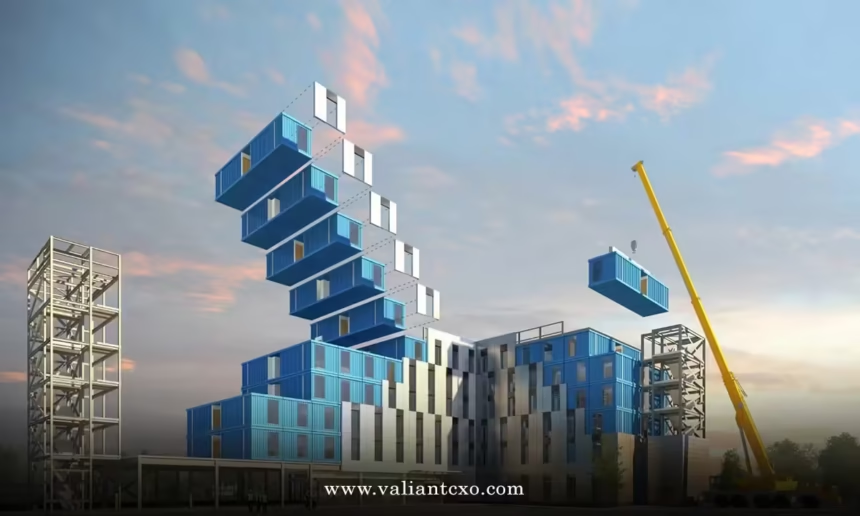
Modular construction methods for data centers 2026 are no longer “experimental” or fringe. They’re how serious operators in the US are compressing timelines, hardening reliability, and keeping capex flexible while demand for AI and cloud capacity goes vertical.
Here’s the fast version before we get into the weeds.
- Design + build in factory, plug in on site. Think “data center LEGO,” but engineered for Tier III+ uptime.
- Shaves months off schedules compared with stick-built projects, and helps align capacity with demand instead of overbuilding.
- Supports AI/edge growth with repeatable blocks: power modules, IT modules, cooling skids, and full prefabricated halls.
- Helps with U.S. code compliance, labor shortages, and ESG reporting when done with standardized designs and documented QA.
What “modular construction methods for data centers 2026” Actually Means
The phrase gets abused, so let’s pin it down.
In my experience, when operators say modular in 2026, they usually mean some mix of:
- Prefabricated power modules
- Factory-built containers or skids with UPS, switchgear, batteries (often lithium-ion), sometimes MV gear.
- Pre-wired, pre-tested, ship-to-site and connect.
- Modular IT/white space
- Containerized or pod-based IT rooms with racks, containment, in-row or rear-door cooling, structured cabling, and security.
- Can be stacked or arranged in rows to form a larger facility.
- Prefab MEP (mechanical, electrical, plumbing) assemblies
- Chilled water skids, CRAH/CRAC manifolds, busway runs, battery lines, and cable trays built offsite.
- Plug-and-play on site, less field labor.
- Fully modular shells or “data center in a box”
- Complete buildings assembled from repeatable structural modules and standardized interior layouts.
- Favored for edge and secondary markets, but creeping into core metros for certain situations.
The key pattern:
Design once, manufacture many, deploy fast.
And that’s exactly what hyperscalers and colos need as AI clusters chase grid and land availability across the US.
Why modular construction matters more in 2026 than it did in 2020
Three big pressures are driving this:
- AI & high-density loads
- GPU clusters are pushing 30–80 kW per rack and beyond.
- Traditional air-cooled rooms struggle here, so standardized liquid cooling modules and high-density pods are popping up.
- Power & grid constraints
- Getting utility power in key US markets can take years.
- Modular lets you phase in power and IT blocks as allocation and demand line up instead of betting big on day one.
- Labor and supply chain realities
- Skilled trades are scarce. Regional wage and availability issues are real.
- Offsite fabrication centralizes labor and cuts on-site chaos, which aligns with broader construction recommendations from groups like the U.S. Department of Energy and industry reports from Uptime Institute.
Is modular magic? No.
But when structured well, it’s the closest thing data centers get to a production line.
Core types of modular construction methods for data centers 2026
1. Power & electrical modules
If you’re only going to modularize one thing, this is usually where to start.
Typical building blocks:
- Medium-voltage switchgear module
- UPS and battery room module
- Generator and fuel system skids
- Pre-integrated controls and monitoring
Benefits you’ll actually feel:
- Speed: Pre-integrated and factory-acceptance-tested power gear saves weeks of field commissioning.
- Consistency: Each site looks and behaves like the last, which simplifies operations and training.
- Maintainability: Easy swap-out or expansion without ripping apart the building.
2. IT white space modules
These come in different flavors:
- ISO-style containers (20’/40’) — popular for edge, some industrial sites, smaller enterprise deployments.
- Larger modular rooms — multiple pods assembled into a bigger white space with shared corridors and support spaces.
- Specialized AI pods — high-density racks with direct-to-chip or rear-door liquid cooling and tailored power distribution.
What usually happens is this:
Operators start with “just” a modular power yard and end up modularizing at least part of the white space once they see the schedule and QA benefits.
3. Cooling & mechanical skids
Cooling is where modular construction quietly pays off.
Common approaches:
- Chilled water plant skids with pumps, controls, heat exchangers.
- Condenser water skids and cooling tower assemblies.
- Direct-to-chip liquid cooling manifolds with standardized distribution panels.
Why it matters:
- High-density AI loads demand precise, reliable cooling.
- Factory-built systems allow more rigorous testing and instrumentation.
- Helps align with ASHRAE guidelines and evolving best practices without redesigning every facility from scratch.
For reference on data center environmental and cooling guidance, many teams align parameters with ASHRAE TC 9.9 recommendations, which remain a go-to standard across the industry.
4. Structural and building modules
This is the “full send” option.
- Structural frames and wall panels repeated across bays.
- Pre-engineered roof, support, and mezzanine modules.
- Standardized “IT block” plus “support block” layout repeated across a campus.
This is closer to how some industrial facilities and warehouses are built across the US, just tuned for data center loads, egress, seismic, and fire requirements.
Quick comparison: modular vs traditional builds in 2026
Here’s a simple, answer-ready table you can drop into any planning deck.
| Dimension | Modular Construction (2026) | Traditional Stick-Built DC |
|---|---|---|
| Schedule | Parallel factory + site work; often shortens delivery by months for comparable scope. | Sequential construction; schedule more exposed to weather and local labor delays. |
| Capex Phasing | Easier to add capacity in blocks (power/IT), aligning spend with demand. | Larger upfront investment; harder to right-size early phases without redesign. |
| Quality & Testing | Factory QA, repeatable builds, standardized FAT/SAT processes. | Heavier reliance on field assembly and testing, more variation between sites. |
| Flexibility for AI & High Density | Can standardize high-density modules and liquid cooling skids. | Often requires retrofit or custom engineering for new density profiles. |
| Regulatory & Codes (U.S.) | Must coordinate state/local code compliance plus factory inspections; benefits from repeatable approvals. | Well understood by AHJs but more site-specific and bespoke each time. |
| Site Disruption | Less on-site construction congestion; shorter peak manpower. | Longer, more intense on-site work; more traffic and laydown requirements. |
| Best Use Cases | Phased campuses, edge sites, fast-track AI expansions, constrained labor markets. | Flagship campuses, highly customized facilities, unique brownfield constraints. |
How modular construction methods for data centers 2026 fit US codes and standards
This is where beginners get nervous, and rightly so.
You’re not bypassing US regulations with modular. You’re adding another layer: the factory.
Key points:
- Building codes: Local Authorities Having Jurisdiction (AHJs) still enforce International Building Code–based requirements, fire/life safety, egress, structural, and occupancy.
- Electrical codes: NEC compliance still applies, and inspectors may want to see documentation from the factory as well as on-site testing.
- Energy and efficiency: Many states and cities push for energy codes and efficiency reporting aligned with federal and state goals; modular designs must meet those, not dodge them.
The U.S. Department of Energy and related programs regularly publish resources on data center energy efficiency and design best practices. Using those as a benchmark when setting modular specs helps keep long-term operating costs and regulatory risk under control.
From my perspective, the teams that win here bring AHJs into the conversation early, share factory QA procedures, and treat inspectors like partners, not obstacles.
A practical step-by-step action plan for beginners
If you’re just starting to explore modular construction methods for data centers 2026 in the US, use this as your baseline playbook.
Step 1: Define the problem, not the solution
- Are you trying to hit a shaving-tight go-live date?
- Do you need flexible capacity because demand is uncertain?
- Is local labor a bottleneck?
Write that down. It guides which modular approach actually makes sense.
Step 2: Select the modular scope
Start with a targeted chunk instead of “everything modular.”
Common beginner-friendly scopes:
- Power yard modules only (UPS, MV/LV gear, batteries)
- Cooling skids for a traditional white space
- Edge/remote sites using fully modular containers
Once you’ve run one project successfully, you can expand.
Step 3: Build a reference design
This is non-negotiable.
- Create a standard “kit of parts” that you can reuse: power blocks, IT blocks, cooling blocks.
- Lock in key electrical one-lines, mechanical schematics, and layout rules.
- Map each block to specific power densities (e.g., 10 kW, 30 kW, 60 kW racks).
In my experience, the teams that skip a proper reference design end up with “modular snowflakes” — everything is bespoke, nothing is repeatable, and all the benefits evaporate.
Step 4: Pick partners with real manufacturing muscle
You’re not just buying gear; you’re buying a supply chain.
What to validate:
- Factory capacity and lead times.
- Experience building for US code environments and Tier III/Tier IV type requirements.
- Documented QA, including factory acceptance testing, traceability, and documentation you can share with AHJs.
Using vendors who already support large cloud and colocation operators can reduce your learning curve.
Step 5: Engage AHJs and utilities early
Don’t spring modular on inspectors at 90% design.
Instead:
- Walk them through the modular concept and the factory QA process.
- Share sample drawings and spec sheets.
- Clarify how inspections will be handled (factory vs field).
For utilities, modular also matters because:
- Load steps may come in large, repeatable increments.
- Transformers, feeders, and protection schemes need to match your phasing plan.
Step 6: Plan logistics like a manufacturing project
This is where modular feels different.
You’re coordinating:
- Factory slots
- Transport routes and timing
- Site readiness (foundations, pads, tie-ins)
- Cranes and rigging
Treat it like a mini supply chain project, not just a standard GC schedule line item.
Step 7: Standardize commissioning
Commissioning is your safety net.
What I’d do if I was running my first modular program:
- Define standard test scripts across all modules.
- Split responsibility clearly between factory tests and site tests.
- Capture lessons learned aggressively and feed them into the next iteration of the reference design.
That’s how you move from “one-off project” to “modular program.”

Common mistakes with modular construction (and how to fix them)
Mistake 1: “We’ll just buy modular and figure out the design later”
This is probably the most expensive trap.
- Without a clear reference design, every site becomes a negotiation.
- Integration between vendor modules and base building systems gets messy.
Fix:
Create a minimal but solid standards package: reference one-lines, block diagrams, interface points, and naming conventions. Start small, but write it down.
Mistake 2: Ignoring operations and maintenance workflows
Shiny modules that are a nightmare to maintain are still a nightmare.
Think about:
- Access paths for equipment replacement.
- How your operations team will safely isolate and work inside modules.
- Integration with your DCIM/BMS stack.
Fix:
Get operations engineers in design reviews early. At least once, walk through “replace a UPS module” or “swap a pump” on paper with the people who will actually do it.
Mistake 3: Underestimating transport and site constraints
A beautiful factory build that can’t get down the access road is useless.
Fix:
Validate:
- Module dimensions, weights, and crane capacities.
- Local road restrictions, turning radii, and seasonal access issues.
- Site laydown space for temporary staging.
Sound basic? It is. And yet, this still bites teams every year.
Mistake 4: Not aligning modular blocks with AI and future density
You don’t want to design 2026 infrastructure for 2018 workloads.
Fix:
- Decide up front whether your standard blocks support air-cooling only, liquid-ready, or liquid-first designs.
- Design busway, cabling, and cooling manifolds to accommodate at least one density step beyond what you need today.
- Use publishable guidance from ASHRAE and leading GPU vendors as benchmarks for temperature, airflow, and liquid cooling parameters.
Mistake 5: Poor documentation handover
Factory documentation goes missing, and three years later nobody knows what’s in the modules.
Fix:
Set contractual expectations:
- As-built drawings tied to each module serial.
- Configuration data for protection settings, firmware, and controls.
- Digital documentation (ideally integrated into your CMMS/DCIM).
Treat documentation as a deliverable, not an optional extra.
Advanced considerations: sustainability, efficiency, and ESG
You’ll hear a lot about sustainability in data centers, but here’s the practical angle.
- Embodied carbon: Modular doesn’t automatically mean lower embodied carbon, but factory settings make it easier to measure and optimize materials.
- Operational efficiency: Standardized cooling and electrical architectures help hit strong PUE targets consistently across sites.
- Reporting and compliance: If you’re aligning with broader energy or climate frameworks in the US or globally, modular blocks make it easier to measure and compare performance across your fleet.
Large technology companies and industry working groups often publish public sustainability reports and data center design guidance that can help benchmark where you stand and what to target in your own program.
The kicker is this:
Good modular design makes doing the right thing repeatable, not heroic.
How to get started with modular construction methods for data centers 2026 if you’re intermediate
If you’ve already built a few sites and want to take the next step:
- Pilot a single-region reference design with modularized power and cooling. Don’t try to standardize worldwide on day one.
- Create a “pattern library” for your campus: e.g., 2 MW power blocks, 4 MW and 8 MW IT blocks, separate AI/CPU blocks.
- Benchmark lifecycle cost, not just build cost. Look at downtime risk, operations headcount, and upgrade flexibility.
Ask yourself:
If you had to deploy three new sites on different US grids over the next 24 months, how much would actually stay the same?
If the answer is “not much,” modular is your chance to fix that.
Key Takeaways
- modular construction methods for data centers 2026 center on factory-built power, IT, and cooling modules that plug together on site to cut schedules and increase repeatability.
- The real value isn’t the container; it’s the reference design and standard kit of parts that you can reuse across sites and phases.
- Start with targeted scopes like power or cooling modules, then expand once your team and AHJs are comfortable.
- Common pitfalls include weak standards, ignoring operations, and underestimating logistics; all are solvable with early planning and clear documentation.
- High-density AI and liquid cooling requirements make modular especially attractive in 2026, as new workloads demand fast, consistent infrastructure.
- Treat modular as a long-term program, not a one-off project, with commissioning scripts, documentation, and partner selection aligned to repeatability.
- Good modular design makes code compliance, efficiency, and ESG reporting easier to manage across a portfolio rather than harder.
When modular is done right, you’re not just building one data center faster.
You’re building a repeatable machine for rolling out capacity wherever your business and the grid can support it next.
FAQs
1. Are modular construction methods for data centers 2026 only suitable for small or edge sites?
No. While modular shines for edge and smaller deployments, many operators now use modular construction methods for data centers 2026 at multi-megawatt campuses by standardizing power yards, cooling plants, and even full white space blocks. The difference is that large sites often combine modular blocks with more conventional shells or site infrastructure.
2. How do modular construction methods for data centers 2026 handle high-density AI workloads?
High-density AI clusters benefit from modular construction methods for data centers 2026 because you can design specialized liquid-ready or liquid-first IT and cooling modules, then repeat them as demand grows. Instead of retrofitting a whole facility, you drop in additional high-density blocks that already match your power, cooling, and monitoring standards.
3. Do modular construction methods for data centers 2026 lock me into specific vendors?
Not if you design it right. If you base your modular construction methods for data centers 2026 on open, clearly defined interfaces—electrical connection points, cooling pipe standards, communication protocols—you can qualify multiple vendors to build compatible modules. Lock-in usually happens when the design is opaque or proprietary, not because modular is inherently restrictive.