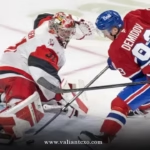
NHL playoff betting hits different. The pace tightens, star players log huge minutes, coaches shorten benches, and every mistake feels like a turnover in a championship game. If you’re betting it like a random January Tuesday, you’re leaving money on the table.
This NHL playoff betting guide walks you through how to think, what to bet, and where casual bettors usually get burned—so you don’t.
Why NHL Playoff Betting Is Not the Regular Season
Same sport, different animal.
Playoff hockey:
- Features tighter checking and more conservative systems
- Pushes stars to 22–28 minutes a night
- Turns special teams and goaltending into series-swinging forces
- Invites emotional overreactions after every game
In my experience, the edge in the postseason comes less from “hot takes” and more from recognizing how teams adapt over a series.
If you want a live example of how this works in a specific matchup, tying this guide to a deeper breakdown like a Canadiens vs Hurricanes Game 4 prediction 2026 Eastern Conference Final article is a smart move. That’s where you can see theory meet real-world pricing, line movement, and series context.
Step 1: Build a Bankroll Plan Before the Puck Drops
You can’t out-handicap bad money management.
Set a Real Bankroll
Your bankroll is the total amount you’re genuinely willing to risk on NHL playoff betting for the full postseason—not just one series.
- Think in terms of a season budget, not “what I feel like tonight”
- Keep it separate from your regular savings or bills
- Assume it can go to zero and you’ll still sleep fine
Use Units, Not Emotions
Instead of guessing stake sizes, standardize:
- 1 unit = 1–2% of your bankroll
- Typical bet: 1 unit
- Bigger edge: 1.5–2 units max
- Never 5–10 units because you “love the spot”
What usually happens when people skip this? One bad beat, one OT loss, and they tilt-chase. That’s how good ideas turn into ugly weeks.
Step 2: Understand Playoff-Specific Market Types
You don’t need every market. You need the right markets.
1. Moneyline (ML)
You’re betting which team wins the game. Simple, but the price matters.
- Favorites are negative odds (e.g., -140)
- Underdogs are positive (e.g., +120)
In the playoffs, books bake in public narratives: “must-win,” last change at home, or a goalie’s recent hot streak. That can tilt value toward the calmer, less popular side.
2. Puck Line (PL)
The NHL version of a spread, usually -1.5 or +1.5.
- Favorite -1.5 means they must win by 2+
- Underdog +1.5 means they can win or lose by 1
These are often driven by empty-netter risk late in games. If a trailing team pulls the goalie early, puck line outcomes can swing in seconds.
3. Totals (Over/Under)
You’re betting on total goals scored by both teams combined.
Playoff totals tend to be lower than regular season:
- Systems tighten
- Coaches avoid wild, track-meet hockey
- Refs sometimes allow more physical play
You’ll often see 5 or 5.5 instead of 6 or 6.5. Shop around—half a goal is huge.
4. Series Prices
Instead of one game, you bet who wins the series.
- Great if you’ve got a strong macro view of how teams match up
- Less variance than a single game
- Lets you exploit overreactions after Game 1 or 2
Example: If a favorite loses Game 1 but dominates shots and expected goals, you might get a better price on them to still win the series.
5. Props & Derivatives
- Player props (shots, points, goals)
- Period totals
- Team totals
This is the fun stuff—but it’s where undisciplined bettors torch their bankrolls. Use props as supplements, not your primary exposure.
Step 3: Use Data, Not Just Highlights
You don’t need to be a analytics nerd, but you do need to look beyond the scoreboard.
Basic Stat Checks
Before betting a playoff game, check:
- Shots on goal
- Power-play and penalty-kill percentages
- Faceoff share
- Hits and blocked shots (for physicality/attrition)
These are all available on the official NHL stats site and major sports networks.
Advanced Metrics That Actually Help
A few easy stats make a big difference:
- Corsi/Fenwick: Shot attempts and unblocked attempts. Show territorial edge.
- Expected Goals (xG): Estimates chance quality. A team winning on low xG and high shooting % might be due for regression.
- High-danger chances: Tells you who’s getting real chances from prime scoring areas.
If Team A is up 2–1 in the series but getting crushed in xG, you know the scoreboard might be flattering them. That matters for both game and series bets.
Step 4: Factor in Playoff-Only Dynamics
This is where a real NHL playoff betting guide separates from generic “how to bet” fluff.
Coaching Adjustments
Game 1 and 2 are information-gathering. By Game 3 and 4:
- Coaches hard-match lines (best D vs best F)
- Struggling players get benched or demoted
- Systems are tweaked to neutralize strengths
If you want to see a specific example of how those adjustments shape a game, studying a series-focused breakdown like a Canadiens vs Hurricanes Game 4 prediction 2026 Eastern Conference Final piece helps you understand how coaches change matchups and line usage mid-series.
Goalie Variance
Goalies will:
- Steal games they have no business winning
- Implode for one night and look elite the next
Don’t anchor solely on one bad or brilliant performance. Broader sample stats (season-long save percentage, high-danger save rate) matter more than one box score.
Travel and Rest
Deep series with heavy travel:
- Can fatigue older cores
- Help deeper teams with three scoring lines and a strong third pair
- Influence coach decisions on bench shortening
Pay attention to OT games. A double-OT grinder leaves both teams gassed, but especially relies more on depth the next time out.

Step 5: Simple Betting Framework for Each Game
Here’s a repeatable process you can run for every NHL playoff game.
- Check injuries & starting goalies
- Confirm expected starters from team/league sources.
- Look for missing top-four defensemen or PP quarterbacks.
- Review last 2–3 games of the series
- Shots, xG, penalties, special teams, high-danger chances.
- Was the scoreline “honest,” or did goaltending/special teams skew it?
- Identify game state expectations
- Does one team trail in the series and need to push pace?
- Is a coach likely to shorten the bench and ride the top line?
- Pick your lane
- Side (ML/PL), total, or a single prop you can justify with numbers.
- Avoid overstacking a single narrative with five correlated bets.
- Size it with discipline
- 1–2 units. No “this is the one” bets.
- Win or lose, you should be comfortable with the stake.
Common NHL Playoff Betting Mistakes (And How to Fix Them)
1. Overreacting to One Game
One blowout and everyone thinks the series is over.
Problem: You see a 6–1 win and assume dominance.
Fix: Check shot share and xG. If the “losing” team still drove play, that blowout might be a buy-low signal.
2. Betting Only Favorites Because “They’re Better”
Favorites lose. A lot.
Problem: Taking every higher seed or media darling.
Fix: Think in probabilities. A -150 favorite still loses about 40% of the time. The question is whether the line matches reality.
3. Chasing “Must-Win” Narratives
“Team X has to win, or they’re done!”
Books know. Lines adjust.
Problem: Oversizing bets because a team faces elimination.
Fix: Treat must-win games like any other, but with an eye on desperation-driven pace or goalie pulls that might affect totals and props.
4. Same-Game Parlay Addiction
High payout screenshots are seductive.
Problem: Stringing together five correlated legs for a longshot.
Fix: Use same-game parlays rarely, and only as entertainment, not core strategy.
5. Ignoring Series Bets
Some of the best edges hide in series prices, not single games.
Problem: Only betting nightly moneylines.
Fix: When you have a strong macro view (e.g., team drives play but is down 0–1), consider the series line instead of hammering every game.
Intermediate Strategies to Level Up Your NHL Playoff Betting
Once you’ve nailed fundamentals, you can layer on some sharper tactics.
Live Betting with Intent
Don’t just chase the score. Follow the flow.
- If a favorite is outshooting an underdog badly but down 1–0 early, live ML or team total overs can be attractive.
- If a game looks like a slog with few chances, live unders or alternate unders can hold value, especially if the pregame line implied more offense.
Correlated Views
If you expect a defensive, grind-it-out game:
- Look at under on the total
- Lower shots props on some depth forwards
- Consider alternative unders for a smaller stake
If you expect a wide-open, high-event game:
- Overs, power-play point props, and higher shot totals on offensive drivers fit the story.
Using Game 4 as a Pivot Point
Game 4 is often the series pivot. Teams either:
- Fight back and reset the series
- Or crumble and watch the opponent tighten the vise
For example, in a matchup broken down in a Canadiens vs Hurricanes Game 4 prediction 2026 Eastern Conference Final, Game 4 would be the perfect case study in:
- Whether Montreal’s youth can sustain pressure
- Whether Carolina’s structure dominates over time
- How goaltending variance either keeps Montreal alive or buries them
Studying that kind of series-specific analysis trains your eye for patterns across other matchups.
How to Handle Emotion and Variance
Let’s be honest: playoff hockey is chaos.
Pucks deflect off skates, refs swallow whistles, a third-line winger becomes a hero out of nowhere. You can’t tame the chaos—but you can manage your reactions to it.
- Accept that even great bets lose often
- Judge yourself by the quality of your reasoning, not one result
- Review big swings with a cool head, not immediately after the final horn
Think of this like weather forecasting. You’re playing probabilities, not guarantees.
Key Takeaways
- NHL playoff betting is a different game from the regular season: tighter systems, bigger minutes for stars, and more emphasis on goaltending and special teams.
- A real strategy starts with bankroll discipline—units, flat staking, and no “all-in because it’s Game 7” moments.
- Use data beyond the scoreboard: look at shots, expected goals, and high-danger chances to see who is truly driving play.
- Focus on a few core markets (ML, PL, totals, series prices), and treat props and parlays as add-ons, not your primary approach.
- Don’t overreact to one game; instead, evaluate whether results match underlying performance across the series.
- Live betting and correlated angles can work—if you have a clear pregame game script and stick to it.
- Studying specific matchups in depth, like a Canadiens vs Hurricanes Game 4 prediction 2026 Eastern Conference Final breakdown, sharpens your ability to read series dynamics and spot mispriced lines elsewhere.
Dial in those habits, and NHL playoff betting stops being a coin-flip thrill ride and starts looking a lot more like a calculated, long-term edge hunt.
FAQs – NHL Playoff Betting Guide
1. What’s the safest type of bet for beginners during the NHL playoffs?
For most beginners, the safest starting point is the moneyline (picking which team wins) with small, flat stakes. It’s simpler than puck lines and props, and if you pair it with basic stats and series context, you’ll avoid a lot of common mistakes.
2. How is NHL playoff betting different from regular-season betting?
Playoff games are usually tighter, more defensive, and more matchup-driven, with coaches leaning heavily on top lines and goalies. That means lower-scoring environments on average, a bigger impact from special teams, and more value in series bets and disciplined unders than in regular-season “track meet” spots.
3. How can I use a specific matchup to improve my playoff betting skills?
Breakdowns of real series—like a detailed Canadiens vs Hurricanes Game 4 prediction 2026 Eastern Conference Final analysis—help you see how theory shows up in actual lines, matchups, and adjustments. Studying those examples trains you to spot edges in other playoff series: who’s controlling play, where the market is overreacting, and which prices are actually worth your money.