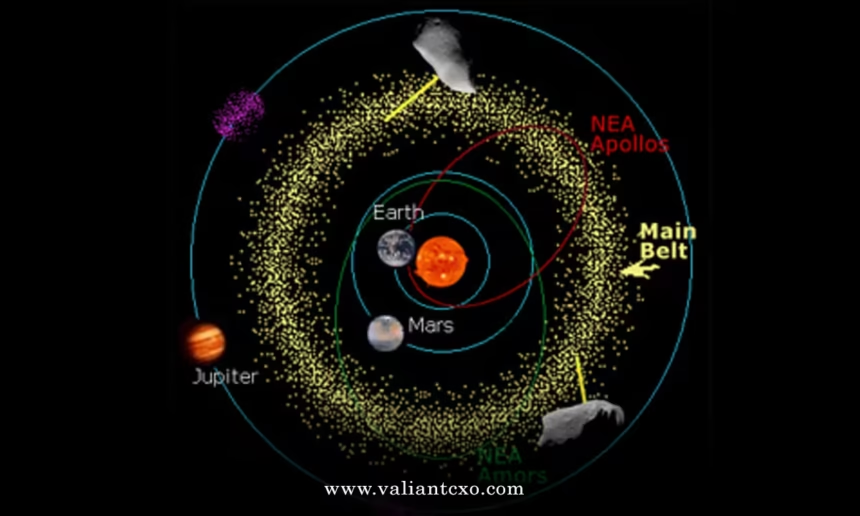
Near-Earth object detection methods keep improving every year. Ground-based telescopes, space infrared platforms, and smarter software now catch asteroids that once slipped past us completely. The goal stays simple: find them early, track their orbits, and judge any risk before they get close.
Here’s the quick overview:
- Wide-field optical surveys scan the night sky repeatedly and flag anything that moves against the stars.
- Image subtraction and machine learning separate real movers from noise and false positives.
- Radar and infrared add size, composition, and better orbits once a candidate appears.
- Space-based infrared missions fill the gaps ground telescopes cannot see, especially toward the Sun.
- Real-world tests, like the short-warning catch of the 2026 RW1 asteroid impact, prove the network works even for meter-class rocks.
These methods form the backbone of planetary defense. Without them, we would still be guessing about most of the nearby population.
Ground-Based Optical Surveys: The Workhorses
Most discoveries still start on the ground. Three main surveys dominate the daily haul: Catalina Sky Survey in Arizona, Pan-STARRS in Hawaii, and ATLAS with stations in Hawaii, Chile, and South Africa.
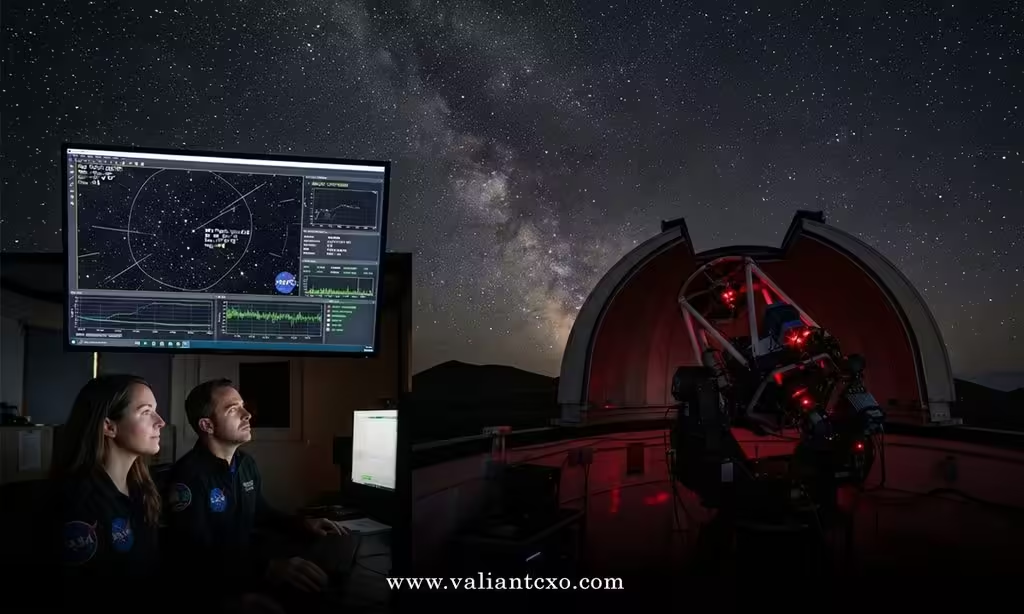
They work the same basic way. A telescope takes a series of short exposures of the same patch of sky, usually four images spaced a few minutes apart. Stars stay fixed. Anything that shifts position becomes a candidate.
The pipeline then runs two checks. Catalog comparison looks for sources that appear in multiple frames at consistent motion rates. Image subtraction removes the static background so faint trails stand out more clearly. Modern systems feed the candidates into convolutional neural networks that score them as real or bogus.
Catalina’s Mount Lemmon telescopes, for example, routinely push detections down to absolute magnitudes around 33 for the smallest objects when they are close. That sensitivity is exactly what allowed the short-arc discovery that led to the 2026 RW1 asteroid impact prediction. Pan-STARRS adds deeper coverage and better seeing. ATLAS prioritizes rapid all-sky coverage to catch imminent threats.
Vera C. Rubin Observatory’s Legacy Survey of Space and Time is now ramping up and will multiply the discovery rate. Its 8.4-meter mirror and wide field will push completeness for 140-meter objects higher than any previous ground system.
Space-Based Infrared: Seeing the Dark Ones
Visible-light telescopes miss a lot. Dark asteroids reflect little sunlight. Objects coming from the daytime sky sit in the Sun’s glare. Infrared solves both problems.
NEOWISE proved the concept by detecting heat signatures rather than reflected light. The upcoming NEO Surveyor, scheduled for launch no later than 2028, takes the next step. Stationed near the Sun-Earth L1 point, it will scan the region ground telescopes cannot reach and measure diameters directly from thermal emission. NASA expects it to push completeness above 90 percent for objects 140 meters and larger within about a decade of operations.
ESA is developing complementary concepts such as NEOMIR to cover similar gaps. Infrared data also reduces the classic size-albedo ambiguity that plagues optical surveys.
Radar and Follow-Up Characterization
Detection is only the first step. Once the Minor Planet Center posts a new candidate, follow-up telescopes refine the orbit. Radar facilities like Goldstone and Arecibo (when available) bounce signals off the object. The return gives precise distance, velocity, size, and sometimes shape and rotation.
Optical follow-up measures light curves for rotation period and estimates composition from colors or spectra. These extra observations turn a short tracklet into a reliable orbit that CNEOS can run through impact probability software.
Synthetic Tracking and Machine Learning Advances
Fast-moving nearby objects create long trails that dilute their signal. Synthetic tracking stacks short exposures along possible motion paths, recovering sensitivity that traditional methods lose. Small telescopes using this technique have already detected 10-meter-class NEOs that standard pipelines missed.
Machine learning now sits inside the real-time pipelines. Convolutional networks trained on both real and simulated data cut false positives and recover fainter detections. The result is higher completeness and fewer wasted follow-up resources.
Comparison of Major Detection Approaches
| Method | Strengths | Limitations | Best For |
|---|---|---|---|
| Ground optical surveys | Wide coverage, rapid cadence, low cost | Weather, daylight, albedo bias | Daily discovery volume |
| Space infrared | Daytime sky, accurate sizes, dark objects | Higher cost, limited lifetime | Completeness for 140 m+ |
| Radar | Precise orbits, physical properties | Limited range and availability | Characterization of known objects |
| Synthetic tracking | Recovers fast movers | Computationally intensive | Small, close NEOs |
| ML-enhanced pipelines | Faster filtering, higher sensitivity | Needs good training data | Reducing false positives |
Data drawn from NASA Planetary Defense Coordination Office reports and published survey performance papers.
Step-by-Step: How a Detection Becomes a Confirmed Orbit
- Survey telescope records a sequence of images.
- Pipeline detects moving sources and scores them.
- Candidates go to the Minor Planet Center for initial orbit fitting.
- Follow-up stations add more positions within hours or days.
- CNEOS and ESA NEOCC compute impact probabilities and close-approach tables.
- If the object is large enough or the risk is non-zero, additional characterization begins.
What I’d do if a new short-warning candidate appears: check the CNEOS Scout page first, then the MPC circulars. Primary sources beat secondary headlines every time.
Common Mistakes and How to Fix Them
Mistake 1: Assuming every new NEO is a threat. Most are not. Fix: look at absolute magnitude and the published impact probability. Values below 1 in a million rarely warrant concern.
Mistake 2: Confusing discovery with characterization. Optical detection gives position and rough size. Radar or infrared gives the real diameter and better physical data. Fix: wait for the follow-up reports before drawing conclusions.
Mistake 3: Ignoring survey geometry. Ground telescopes cannot see near the Sun. Fix: remember that space infrared missions exist precisely to close that gap.
Mistake 4: Overlooking short-arc objects. Meter-scale rocks often appear only days or hours before closest approach. The 2026 RW1 asteroid impact showed that even seven hours of warning is enough for a solid prediction when the network is ready.
Looking Ahead
Rubin’s full survey power plus NEO Surveyor will change the numbers. Completeness for city-killing sizes should climb steadily. Synthetic tracking and better machine learning will keep improving the faint-end performance that catches the small, close objects.
The methods already work. Each successful short-warning detection, including the 2026 RW1 asteroid impact, simply confirms the pipeline is doing its job.
Key Takeaways
- Ground optical surveys still deliver the majority of new NEO discoveries through repeated wide-field imaging and moving-object pipelines.
- Image subtraction, catalog matching, and machine learning form the core of modern detection software.
- Space-based infrared telescopes overcome daylight and albedo limitations that ground systems face.
- Radar provides the highest-precision orbits and physical data once an object is known.
- Synthetic tracking recovers sensitivity for fast-moving nearby rocks that traditional methods lose.
- Short-warning successes such as the 2026 RW1 asteroid impact demonstrate that the current network can handle even meter-class objects.
- Future gains will come from Rubin Observatory, NEO Surveyor, and continued software improvements.
Stay with the official sources. The next interesting detection is already being processed somewhere in the pipeline.
FAQs
What is the most common near-Earth object detection method right now?
Wide-field ground-based optical surveys using sequences of short exposures, image subtraction, and machine-learning filters remain the primary discovery channel.
How did near-Earth object detection methods catch the 2026 RW1 asteroid impact so quickly?
Catalina Sky Survey telescopes detected the faint mover, the pipeline flagged it, and automated systems plus rapid follow-up refined the orbit in time for a confirmed prediction hours before entry.
Will space telescopes replace ground surveys for NEO detection?
No. They complement each other. Ground systems provide high-volume daily coverage. Space infrared fills the geometric and albedo gaps that ground telescopes cannot reach.