Running a small business means you’re always “on.” Your phone is your inbox, your meeting room, your marketing hub, and sometimes your customer support desk. When that device is slow, unreliable, or constantly dying on you, it doesn’t just annoy you—it eats into your time, your focus, and your revenue.
So, let’s talk about the best phones for small business owners in a simple, practical way. We’re going to look at what really matters: performance, battery, camera, security, and value. And as we go, we’ll show you why the Samsung Galaxy S26 review July 2026 deserves a spot on your shortlist if you’re serious about using your phone as a core business tool.
What Small Business Owners Actually Need From a Phone
Before we list devices, we need to get clear on your real needs, not just fancy specs.
You’re likely juggling email, messaging apps, social media, video calls, cloud storage, and maybe a POS system or booking app. That means you need:
- Strong performance for multitasking
- Reliable all-day battery
- A good camera for content and product photos
- Solid security to protect customer data
- A price that makes sense for your budget
If a phone does those five things well, it’s already a strong candidate for your business.
Samsung Galaxy S26: A Flagship Built for Work
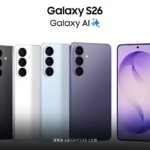
We can’t talk about the best phones for small business owners without highlighting Samsung’s latest flagship. As we explored in our Samsung Galaxy S26 review July 2026, this phone is built to handle serious work, not just casual scrolling.
You get fast performance from the latest Samsung chipset, strong multitasking, and generous RAM so apps don’t constantly reload. The camera is excellent for product shots, team photos, and social media content. Battery life comfortably covers a full workday in mixed use, and fast charging gets you back on track quickly when things are busy.
Security is a major plus, with Samsung Knox and advanced biometrics helping you keep sensitive information safer. For small business owners who want a premium “do it all” device that can act as a mini office, the Galaxy S26 is one of the best options right now.
Apple iPhone 16: For the Ecosystem-Driven Business Owner
If your business lives inside the Apple ecosystem—MacBook, iPad, Apple Watch—then the iPhone 16 is a natural option.
You get:
- Fast, reliable performance for daily business apps
- A strong camera system that makes brand photos and video look polished
- Tight integration with iMessage, FaceTime, and iCloud for smooth communication and backup
- Regular software updates and strong security features
For small business owners who already use Apple devices, the iPhone 16 is more than just a phone; it’s the glue that holds your digital setup together. It’s a great choice if you value simplicity and a seamless ecosystem.
Google Pixel 9: Smart Tools for Busy Owners
The Google Pixel 9 is another strong candidate among the best phones for small business owners, especially if you lean heavily on Google’s tools.
Here’s why it works well for business:
- Clean Android experience with fast updates
- Deep integration with Gmail, Google Calendar, Drive, Docs, and Meet
- Excellent camera with smart AI features that make photos and video look great with minimal effort
- Helpful AI features for call screening, transcription, and smart replies
If your business lives in Google Workspace and you want a phone that feels “tuned” for that world, the Pixel 9 is a very sensible choice.
Mid-Range Phones That Still Make Business Sense
Not every small business owner needs a flagship. If you’re on a tighter budget or just starting out, mid-range phones can offer serious value.
Strong mid-range options include:
- Samsung Galaxy A-series: Reliable performance, decent cameras, and good battery life at lower prices.
- Apple iPhone SE (latest version): Brings core iPhone strengths—speed, security, ecosystem—at a more accessible cost.
- OnePlus and similar brands: Often offer fast performance and clean software at mid-range prices.
These devices won’t match the power and polish of something like the Galaxy S26 or iPhone 16, but they may be more than enough if your work is mostly email, messaging, and basic apps.
How to Choose the Right Phone for Your Business
Rather than chasing the “best” phone in general, focus on what’s best for your specific situation. Ask yourself:
- How much do I rely on my phone for sales and operations?
If your phone is the center of your business, leaning toward a flagship like the Samsung Galaxy S26 or iPhone 16 makes sense. - Which ecosystem am I in—Google, Apple, or Microsoft?
Stick with the phone that plays nicest with your existing tools to avoid tech headaches. - What’s my realistic budget for the next 2–3 years?
Think of the phone as an investment, not a one-time cost. If a more expensive device saves time, reduces hassle, and improves your content, it can pay for itself. - How important is content creation to my marketing?
If you rely heavily on social media, video, and visuals to win customers, prioritize camera quality and storage.
Why the Galaxy S26 Deserves Special Attention
Among the best phones for small business owners, we keep coming back to the Samsung Galaxy S26 for a simple reason: it’s built for heavy use. For entrepreneurs who live on their phones, it offers a strong mix of performance, battery, camera, and security.
If you’re weighing options right now, it’s worth going deeper into the Samsung Galaxy S26 review July 2026 so you can see exactly how it might fit into your daily workflow. The right device won’t run your business for you, but it can remove friction, cut down on problems, and help you stay more responsive to customers and opportunities.
Choosing the best phone for your small business is less about chasing hype and more about picking a reliable work partner that fits how you operate. Whether you go for the Samsung Galaxy S26, an iPhone, a Pixel, or a mid-range alternative, the goal is simple: your phone should help your business run smoother, not add more stress to your day.