Council tax bands explained UK style usually means a confusing table and a lot of jargon. Let’s fix that right now, plainly, without the fluff.
Here’s the short version before we get into the weeds:
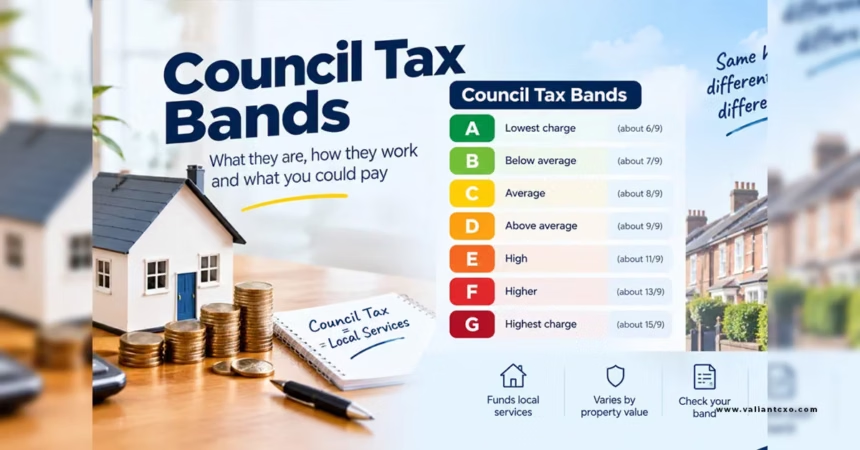
- Every home in England sits in one of eight bands, A to H, based on what it was worth back on 1 April 1991 — not today’s value.
- Each band carries a fixed ratio relative to Band D, which is the benchmark figure every council sets first.
- The average Band D bill in England for 2026-27 sits around £2,391.52 before water and sewerage charges.
- Bills vary wildly by council — from roughly £1,028 in Wandsworth to £2,765 in Dorset for the same Band D — because each local authority sets its own rate on top of the national framework.
- There’s a growing push to scrap this whole system entirely, via proposals to scrap council tax and stamp duty proportional property tax UK 2026, which we’ve covered in detail elsewhere.
Right, let’s break the actual bands down.
What Are Council Tax Bands, Really?
Picture council tax like a tax bracket system frozen in amber from 1991. That’s not a joke — it’s the literal truth. The Valuation Office Agency assessed every home’s value back then, slotted it into a band, and England has mostly been coasting on that snapshot ever since.
Your home could have doubled in value since then. Could’ve had an extension built. Doesn’t matter. Unless there’s been a sale, a major change, or a successful challenge, your band stays put.
Wales revalued in 2003, so its bands reflect that later date instead. Scotland still uses 1991 values too, much like England. That regional split trips a lot of people up.
The Council Tax Bands Explained: A to H
Here’s the actual breakdown, using the 1991 valuation thresholds that still govern England today.
| Band | 1991 Property Value Range | Ratio to Band D | Example Annual Bill (England, 2026-27 avg.) |
|---|---|---|---|
| A | Up to £40,000 | 6/9 | ~£1,594 |
| B | £40,001 – £52,000 | 7/9 | ~£1,860 |
| C | £52,001 – £68,000 | 8/9 | ~£2,125 |
| D | £68,001 – £88,000 | 9/9 (baseline) | ~£2,392 |
| E | £88,001 – £120,000 | 11/9 | ~£2,924 |
| F | £120,001 – £160,000 | 13/9 | ~£3,455 |
| G | £160,001 – £320,000 | 15/9 | ~£3,986 |
| H | More than £320,000 | 18/9 | ~£4,784 |
See the problem? A Band H home pays double a Band D home, but today’s actual value gap between a £320,000 house and a £2 million mansion could be ten times bigger than that ratio reflects. The bands were never designed to track modern wealth — they track 1991 wealth, frozen.
Why Your Band Might Be Wrong
This isn’t rare. Thousands of homes sit in the wrong band, often because the original 1991 assessment was rushed — some were literally estimated from the curb, a method nicknamed “second gear valuations” because assessors are said to have driven past at speed.
What usually happens is neighbours on the same street, in near-identical houses, end up in different bands. One pays hundreds more a year than the other for no good reason.
Common causes I’d flag if a client asked me to check this:
- The property was valued incorrectly from the start.
- An extension or major renovation happened, and the band was never updated.
- The home was split into flats or merged with another property.
- A straightforward clerical error during the original 1991 survey.
Step-by-Step: How to Check and Challenge Your Band
- Find your current band. Look it up free via the Valuation Office Agency’s website for England and Wales.
- Compare with neighbours. Check similar properties on your street using the same tool — if several comparable homes sit in a lower band, that’s a red flag.
- Work out the 1991 value yourself. Take today’s market value, then roughly adjust it back using a recognised house price index to estimate what it might’ve sold for in April 1991.
- Gather evidence. Sale prices of similar local homes around 1991, or at least comparable band placements nearby, strengthen any challenge.
- Submit a formal challenge, not just a complaint, through the official channel for your nation — England and Wales go through the VOA, Scotland through the Scottish Assessors Association.
- Be patient and be careful. A challenge can also move you up a band if you’re wrong about being over-charged — it’s a genuine two-way risk, not a one-way freebie.
- Keep records of everything. If the band changes, confirm backdating and any refund owed in writing.
Common Mistakes & How to Fix Them
Mistake 1: Assuming a higher band always means a worse deal. Not necessarily — some genuinely higher-value homes belong there. Fix: compare against actual comparable properties, not gut feeling.
Mistake 2: Challenging without evidence. A hunch isn’t enough. Fix: pull genuine 1991-era comparables or adjusted valuations before you submit anything.
Mistake 3: Confusing council tax bands with the rateable value system used for business premises. Totally different system, different rules. Fix: confirm you’re looking at domestic council tax, not business rates.
Mistake 4: Ignoring the bigger reform conversation. A lot of homeowners fixate on their individual band and miss that the whole structure is under political pressure. The push to scrap council tax and stamp duty proportional property tax UK 2026 would replace this entire banding system with a flat percentage of current property value — so understanding your band now helps you judge whether you’d win or lose under that kind of reform.
Mistake 5: Forgetting regional differences. England, Wales, and Scotland all run separate valuation lists with different base years. Fix: always check the rules for your specific nation.
Key Takeaways
- Council tax bands run A to H in England and Scotland, based on 1991 property values — not current ones.
- Wales uses its own updated 2003 valuation list.
- Each band is a fixed ratio of Band D, which acts as the system’s benchmark figure.
- The England average Band D bill for 2026-27 is roughly £2,391.52, before water charges.
- Actual bills vary enormously by council area — more than £1,700 difference between the cheapest and priciest Band D areas.
- Wrong bands are common and can be formally challenged through the VOA or Scottish Assessors Association.
- Ongoing reform proposals — to scrap council tax and stamp duty proportional property tax UK 2026 — would eventually replace this entire banding structure with a value-based annual charge.
Here’s the honest bottom line: council tax bands are a relic doing a modern job badly. Check yours, compare it against your street, and challenge it if the numbers don’t add up — that’s a concrete step you can take today, reform or no reform. And if you want the bigger picture on where this system might be headed, it’s worth reading up on the proposals to scrap council tax and stamp duty proportional property tax UK 2026, since that would change everything laid out above.
FAQs
Does checking my council tax band cost anything?
No. Looking up your band through the Valuation Office Agency is free, and submitting a formal challenge costs nothing either.
Could a council tax band challenge backfire?
Yes — if an assessment finds your home was actually undervalued, your band could move up rather than down. Weigh the evidence carefully before applying.
Would the move to scrap council tax and stamp duty proportional property tax UK 2026 make bands irrelevant?
If that reform passed, yes — bands would disappear entirely, replaced by a flat percentage charged on your home’s current market value rather than its 1991 valuation.