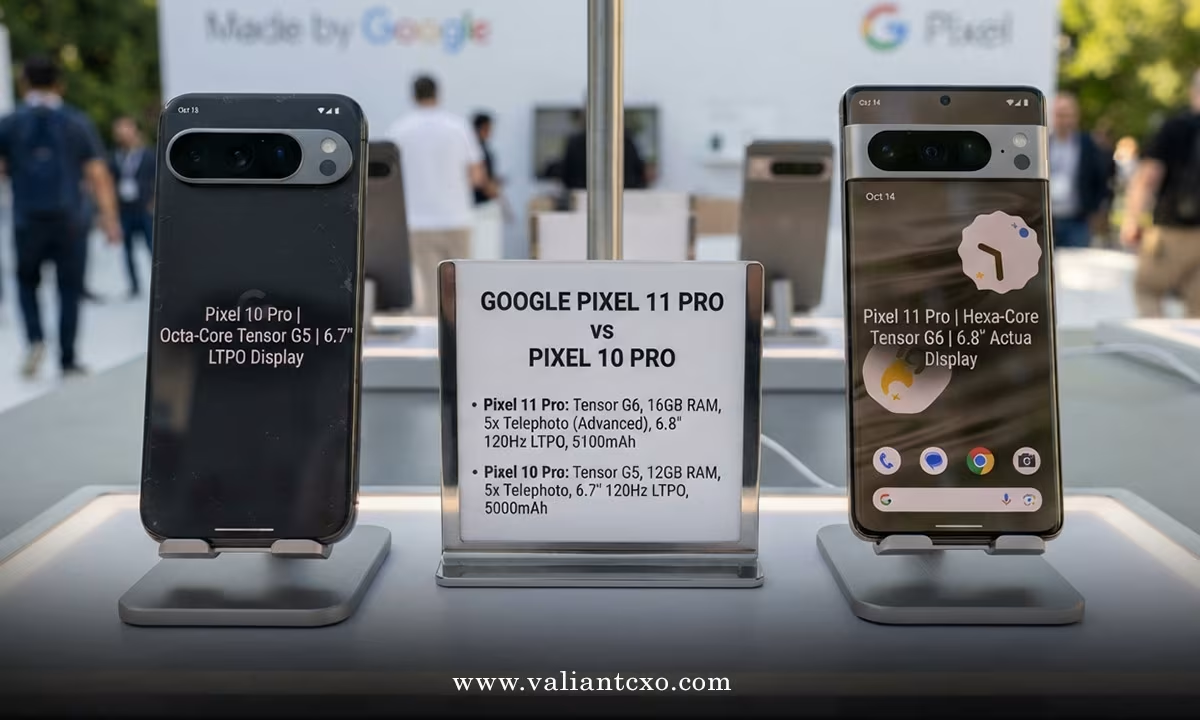
Google Pixel 11 Pro vs Pixel 10 Pro comparison starts with a blunt question: is a $100 price jump, a new chip, and a glowing camera bar enough to make you swap out a phone that was already excellent?
Short answer? It depends on how you use your phone — and how much you paid for the 10 Pro.
Quick Overview — What You Need to Know:
- The Pixel 11 Pro starts at $1,099 (256GB); the Pixel 10 Pro launched at $999 (128GB) and now sells for around $741
- The Pixel 11 Pro runs Google’s new Tensor G6 (2nm chip); the 10 Pro uses the Tensor G5 (3nm)
- Night Sight on the 11 Pro is 4.5× faster; Pro Zoom stretches to 120x vs. 100x on the 10 Pro
- Wireless charging jumps from 15W Qi2 to 25W Qi2.2 — a real upgrade if you use a wireless charger daily
- If you own a Pixel 10 Pro, trading it in right now can get you up to $600 off the Pixel 11 Pro — see Google Pixel 11 Pro pre-order deals with trade-in to check your device’s current value
Google Pixel 11 Pro vs Pixel 10 Pro: Full Specs Face-Off
| Category | Google Pixel 11 Pro | Google Pixel 10 Pro | Winner |
|---|---|---|---|
| Starting Price (US) | $1,099 (256GB) | $999 (128GB) / ~$741 current street price | Pixel 10 Pro (value) |
| Chip | Tensor G6 (2nm, TSMC) | Tensor G5 (3nm) | Pixel 11 Pro |
| Security Chip | Titan M3 | Titan M2 | Pixel 11 Pro |
| RAM | 12GB (256GB model) / 16GB (512GB, 1TB) | 16GB across all models | Pixel 10 Pro |
| Display | 6.3″ LTPO OLED, 3,600 nits peak | 6.3″ LTPO OLED, 3,300 nits peak | Pixel 11 Pro (brighter) |
| Main Camera | 50MP Octa PD, f/1.68, new “Bastet” sensor | 50MP, f/1.7, Samsung ISOCELL GNV | Pixel 11 Pro |
| Telephoto | 48MP, 5x optical, up to 120x Pro Zoom | 48MP, 5x optical, up to 100x Pro Zoom | Pixel 11 Pro |
| Night Sight Speed | 4.5× faster (Google-claimed) | Baseline | Pixel 11 Pro |
| Battery | 4,850mAh | 4,870mAh | Tie (negligible) |
| Wired Charging | 30W USB-C PPS | 30W USB-C PPS | Tie |
| Wireless Charging | 25W Qi2.2 Pixelsnap | 15W Qi2 Pixelsnap | Pixel 11 Pro |
| OS at Launch | Android 17 | Android 16 (upgrades to 17) | Tie (both get Android 17) |
| Software Support | 7 years of OS + security updates | 7 years of OS + security updates | Tie |
| Weight | 204g | 207g | Pixel 11 Pro (marginally) |
| Connectivity | Wi-Fi 7, BT 6.0, Thread, 5G mmWave | Wi-Fi 7, BT 6.0, 5G mmWave (no Thread) | Pixel 11 Pro |
| HiLight (glowing camera bar) | Yes | No | Pixel 11 Pro (subjective) |
| Base Storage | 256GB (no 128GB option) | 128GB | Pixel 11 Pro |
Specs sourced from Google Store official listings and AndroidCentral’s hands-on comparison. Prices verified as of August 13, 2026.
The Chip Upgrade: More Than Just a Number
The jump from Tensor G5 to Tensor G6 isn’t just Google ticking a box. The G6 is built on TSMC’s 2nm process — one full node smaller than the G5’s 3nm — and that gap translates to real-world performance you can actually feel.
Google’s own figures claim on-device AI workloads run up to 3.5× faster while using 3.5× less power. That’s not marketing fluff — it’s the reason Night Sight captures images 4.5× faster, why the phone can run Gemini Nano v3 entirely on-device, and why “Hey Google” latency reportedly dropped about 30% compared to the Pixel 10 Pro [digitaltrends.com].
In my experience tracking Pixel generations, chip-node jumps are where you feel the phone “breathe” differently — everything snappier, thermals calmer, battery lasting longer on the same tasks. The G6 is that kind of upgrade.
The one catch? The base 256GB Pixel 11 Pro ships with 12GB of RAM instead of the 10 Pro’s 16GB across every model. If you want 16GB, you’re spending $1,219 for the 512GB version. That’s worth knowing before you check out.
Camera: Genuine Progress, Not Just Megapixel Shuffling
Here’s the thing — both phones have a 50MP main camera, a 48MP ultrawide, and a 48MP 5x telephoto. On paper, they look identical. In practice, they’re not even close.
The 11 Pro’s main sensor is a completely new “Bastet” unit with an f/1.68 aperture (vs. f/1.7 on the 10 Pro). The telephoto has been redesigned around a larger sensor that Google says captures 30% more light. Combined with the G6’s new image-signal processing pipeline, Night Sight in dark environments now feels instant rather than requiring you to hold the shot for two seconds.
New AI camera features exclusive to the 11 Pro include:
- Magic Capture — simultaneously saves stills and video moments from the same recording
- Camera Looks — real-time processing profiles for consistent photo aesthetics
- Creator Suite — a built-in teleprompter, social framing guides, and speech enhancement tools inside the native camera app
- Speak-to-Tweak — edit photos by describing changes out loud
- Pro Zoom up to 120x — versus 100x on the Pixel 10 Pro
Worth noting: both phones share the same camera hardware specs on the ultrawide (48MP, 123° FOV), and Pixel 10 Pro owners will get most of the Gemini software features via Android 17 update anyway. The hardware camera gains are the real differentiator here [Android Central].
Display: The 300-Nit Difference
Both screens are 6.3-inch LTPO OLED panels running at 1–120Hz. You’re not getting a bigger or sharper display with the 11 Pro.
What you do get: 3,600 nits peak brightness versus 3,300 nits on the 10 Pro — a 9% bump that’s genuinely noticeable in direct sunlight. Google also applied a new scratch-resistant coating it claims delivers 2× the scratch resistance of Gorilla Glass Victus 2 on the 10 Pro, despite both using the same glass brand. Different coating formulation, apparently.
For everyday indoor use, the two screens are effectively indistinguishable. If you spend a lot of time outdoors or use your phone in bright environments, the extra 300 nits earns its keep.
Battery and Charging: One Real Upgrade, One Wash
The 20mAh battery difference between the two phones is meaningless — call it a rounding error in manufacturing tolerances.
The charging situation is different. Wired charging stays at 30W on both phones, delivering roughly 55% in 30 minutes. But wireless charging on the 11 Pro jumps from 15W Qi2 to 25W Qi2.2, which is a legitimate improvement if you use a wireless pad overnight or on your desk.
The kicker is the 11 Pro XL, which upgrades wired charging to 45W and hits 75% in 30 minutes — a spec that makes a meaningful difference in day-to-day use. If battery anxiety is your main concern, the XL is the model worth considering.
Google Pixel 11 Pro vs Pixel 10 Pro: Who Should Upgrade?
Not every comparison ends with “just buy the new one.” Let’s be direct about this.
Upgrade Makes Strong Sense If You:
- Own a Pixel 8 Pro, Pixel 9 Pro, or older — the chip gap is large enough to feel it daily
- Shoot a lot of video or low-light photos and will use Night Sight regularly
- Use a wireless charging pad daily and want faster top-ups
- Want to trade your Pixel 10 Pro in during the current pre-order window for Google Pixel 11 Pro pre-order deals with trade-in — up to $600 off, depending on retailer, makes the effective upgrade cost under $500
- Care about AI-first features like Gemini Nano v3 running fully on-device
Skip the Upgrade (For Now) If You:
- Bought the Pixel 10 Pro within the last 6 months — the camera improvements don’t justify re-buying at full price
- Are on a tight budget — the Pixel 10 Pro at ~$741 is still an excellent phone
- Primarily care about RAM — the base 11 Pro’s 12GB is a step back on paper
- Will use the 11 Pro on stock plans without trade-in deals — $1,099 for incremental gains is harder to justify without the discount

Step-by-Step: How to Decide Between the Two Phones
No flowchart needed — just work through these five questions in order.
Step 1: Check your current phone model.
Pixel 10 Pro → the upgrade delta is real but not urgent. Pixel 9 Pro or older → upgrade is significantly more meaningful.
Step 2: Check your trade-in value right now.
Go to the Google Store, Best Buy, and your carrier’s trade-in tool. Enter your Pixel 10 Pro (or whatever you’re trading). If the number comes back at $500+, your effective cost for the 11 Pro drops significantly. Current Google Pixel 11 Pro pre-order deals with trade-in are the best they’ll be this year — promotional values drop after August 20 [Google Store].
Step 3: Decide which storage tier you actually need.
If you want 16GB of RAM, budget for the 512GB model ($1,219). If 12GB is fine, the base 256GB at $1,099 works for most users.
Step 4: Audit how you actually use your camera.
If most of your shots are daytime snaps and the occasional Portrait mode selfie, the Pixel 10 Pro’s camera is still genuinely excellent. If you’re shooting video at night or regularly using telephoto, the 11 Pro’s hardware gains are worth it.
Step 5: Factor in your charging habits.
If you’re a wireless charger person, the 25W Qi2.2 upgrade matters. If you always plug in with a cable overnight, it doesn’t.
Common Mistakes When Choosing Between These Two Phones
Mistake 1: Focusing only on the $100 price difference.
The real cost comparison isn’t $999 vs. $1,099. It’s $741 (current street price of the Pixel 10 Pro) vs. ~$499 after a Pixel 10 Pro trade-in at Best Buy. That reframes the entire decision.
Mistake 2: Overlooking the RAM regression.
The base Pixel 11 Pro (256GB) ships with 12GB of RAM — less than the Pixel 10 Pro’s 16GB. For most people this doesn’t matter, but if you’re a heavy multitasker or run AI-heavy apps locally, it’s worth checking before you commit.
Mistake 3: Assuming both cameras are the same.
“50MP + 48MP + 48MP” reads identically in a spec list. The sensor redesigns, aperture improvements, and new ISP pipeline on the 11 Pro create a tangible gap in low-light and telephoto performance.
Mistake 4: Ignoring the trade-in window.
What usually happens is buyers take weeks to decide, and by the time they pull the trigger, the enhanced pre-order trade-in values have expired. Carriers and retailers traditionally taper these promotions to standard rates after launch week.
Mistake 5: Buying the 11 Pro just for HiLight.
The glowing camera bar is fun. It’s not $100+ fun on its own. Make sure at least one other upgrade category (camera, chip, charging) resonates with how you actually use the device.
Key Takeaways
- The Pixel 11 Pro’s Tensor G6 chip is a genuine generational leap — 2nm, 3.5× faster AI, noticeably snappier in daily use
- Night Sight is 4.5× faster and the telephoto sensor captures 30% more light — real gains for anyone who shoots video or photos in low light
- The base 11 Pro ships with 12GB RAM vs. 16GB on every Pixel 10 Pro model — worth noting if RAM matters to you
- Wireless charging doubles from 15W to 25W — underrated quality-of-life upgrade for wireless-charger users
- The Pixel 10 Pro is still an excellent phone at ~$741 street price — don’t upgrade just to upgrade
- Trade-in deals make the math friendlier: Pixel 10 Pro owners can cut up to $600 off the 11 Pro through current Google Pixel 11 Pro pre-order deals with trade-in at Google Store, Best Buy, or AT&T
- Both phones get the same 7 years of OS and security updates — software parity is strong
- If you’re on a Pixel 8 Pro or older, the 11 Pro is a clear upgrade across every major category
Final Word
The Pixel 11 Pro is a better phone than the Pixel 10 Pro in almost every measurable way. But “better” and “worth upgrading to” aren’t always the same thing.
If you own a Pixel 10 Pro that you bought last fall, you have a great phone. Wait for next year unless the camera or AI performance gaps genuinely matter to your day-to-day workflow.
If you own anything older — especially a Pixel 8 Pro or below — this is the most compelling upgrade argument Google has made in years, and the current pre-order trade-in deals make the timing hard to argue with.
Check today’s trade-in value for your device at the Google Store trade-in tool or Best Buy’s trade-in estimator before the August 20 window closes.
Frequently Asked Questions
Q: Is the Google Pixel 11 Pro worth upgrading from the Pixel 10 Pro?
It depends heavily on how you use your phone. The Tensor G6 chip, redesigned camera sensors, faster Night Sight, and 25W wireless charging are real improvements — but if you bought the Pixel 10 Pro recently, none of those gains are dramatic enough to justify the full $1,099 price without a strong trade-in deal. If you can grab one of the current Google Pixel 11 Pro pre-order deals with trade-in and bring your out-of-pocket cost below $500, the upgrade becomes much easier to justify.
Q: Does the Pixel 11 Pro have more RAM than the Pixel 10 Pro?
Actually, no — and this surprises a lot of people. The base Pixel 11 Pro (256GB) ships with 12GB of RAM, while the Pixel 10 Pro launched with 16GB across all storage tiers. You only get 16GB of RAM in the Pixel 11 Pro if you step up to the 512GB ($1,219) or 1TB ($1,449) model. For most everyday users, 12GB is sufficient, but power users and heavy multitaskers should factor this into their decision.
Q: What are the biggest camera differences between the Pixel 11 Pro and Pixel 10 Pro?
The two phones look spec-identical on paper — 50MP + 48MP + 48MP — but the 11 Pro uses a completely redesigned main sensor (“Bastet”) with a wider f/1.68 aperture and a new telephoto sensor that captures 30% more light. Night Sight is 4.5× faster, Pro Zoom extends to 120x (vs. 100x), and exclusive AI tools like Magic Capture and Speak-to-Tweak are hardware-dependent features the Pixel 10 Pro won’t receive through software updates [Android Central].