Night sky viewing doesn’t require a telescope, a degree in astronomy, or a cabin in the desert. It just takes a bit of know-how, decent timing, and the right expectations.
If you’ve ever stepped outside, spotted a bright “star” near the Moon, and thought, “What planet is that?”—you’re exactly who this guide is for.
Quick-Start Night Sky Viewing Cheat Sheet
- Start with naked-eye observing before worrying about gear.
- Learn the big three: Moon phases, bright planets, and a handful of constellations.
- Use a dark, safe location away from harsh lights and high-traffic roads.
- Rely on simple apps or sky charts to confirm what you’re seeing.
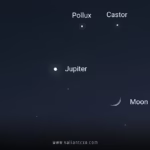
- When you notice a bright object close to the Moon, use a focused guide like what planet is next to the moon tonight May 2026 to identify it fast.
Why a Night Sky Viewing Guide Matters
A good night sky viewing guide does two things:
- Makes the sky less mysterious and more familiar.
- Helps you spend less time guessing and more time actually seeing cool stuff.
The sky is predictable. Your schedule isn’t. That’s why it’s smart to know:
- When the Moon will be bright or dim.
- When planets are well placed.
- How to time your sessions so you’re not just staring at light pollution and wondering what went wrong.
Think of this guide as your starter playbook for making the most of clear nights—without turning it into a full-time hobby (unless you want to).
Step 1: Pick the Right Time and Place
1. Choose a darker spot
You don’t need total wilderness, but you do want:
- Less direct street lighting
- A clear view of the horizon in at least one direction
- A location where you can stand or sit safely for 30–60 minutes
Backyards, parks, and open fields away from busy roads work well. The fewer bright lights in your eyes, the more stars you’ll see.
2. Watch the Moon’s phase
The Moon is both your best friend and your biggest glare bomb.
- Around new Moon: Sky is darkest; best for faint stars and the Milky Way.
- Around first and last quarter: Good mix of lunar detail and visible stars.
- Around full Moon: Great for Moon viewing, but it washes out many faint objects.
In my experience, beginners get the most satisfying results around crescent to quarter phases—enough Moon to enjoy, but not so much brightness that everything else disappears.
This is also when you’re most likely to notice a bright “companion” near the Moon and wonder what planet is next to the moon tonight May 2026 or on any other date.
Step 2: Start with Naked-Eye Observing
Before you touch binoculars or a telescope, get comfortable with:
1. The Moon
Look for:
- Shape (phase): thin crescent, half, gibbous, full.
- Position: low, high, near a bright star or planet.
- Color: yellowish near the horizon, whiter when higher.
The Moon is your anchor. Once you know where it is and how bright it is, everything else in the sky becomes easier to place.
2. Bright planets
Begin with the obvious ones:
- Venus – extremely bright, often visible shortly after sunset or before sunrise.
- Jupiter – bright, steady, looks like a big “star.”
- Mars – often has a reddish tint.
- Saturn – dimmer than Venus or Jupiter, soft yellow glow.
When you notice one of these close to the Moon, that’s when a targeted search like what planet is next to the moon tonight May 2026 earns its keep—it helps you confirm which planet is in play on a specific night.
3. A few easy constellations
You don’t need to memorize the sky. Just learn 3–5 “landmark” patterns:
- Orion
- Big Dipper
- Cassiopeia
- Cygnus
- Scorpius
Once you recognize those, the rest of the sky stops feeling random. The constellations become road signs instead of decorative wallpaper.
Step 3: Use Simple Tools (Without Getting Overwhelmed)
You don’t have to go full gear-head to improve your night sky viewing.
Phone apps & sky charts
Use a reputable sky map app or web-based chart where you can:
- Enter your location
- Set the time and date
- See what’s above your horizon right now
These tools help you identify:
- The bright object near the Moon
- When a specific planet rises or sets
- Whether an interesting alignment is actually visible from your location
When people ask about what planet is next to the moon tonight May 2026, they’re really asking for exactly this kind of real-time confirmation, tailored to where they are.
Binoculars
If you want one piece of gear that multiplies what you can see, it’s this.
- 8×40 or 10×50 binoculars are a sweet spot for beginners.
- You’ll see:
- Craters and terminator detail on the Moon
- Star clusters that looked like fuzzy patches to the naked eye
- Jupiter’s main moons as tiny points of light
Binoculars are forgiving. A telescope is like a high-performance sports car; binoculars are like a reliable pickup truck that just works.
Step 4: Build a Simple Night Sky Routine
To actually make progress, treat night sky viewing as a simple ritual, not a complex project.
Here’s a workable routine:
- Check the forecast and Moon phase
If it’s clear and the Moon is not blindingly full, you’re in business. - Decide your goal for the night
- “Just see the Moon and one bright planet.”
- “Learn one new constellation.”
- “Find out what’s near the Moon tonight.”
- Head out 30–60 minutes after sunset
Enough darkness to see stars, but not too late for work nights. - Use the Moon as your reference point
From there, look for:- Any bright “star” that doesn’t twinkle much
- A reddish point of light
- Patterns you recognize
- Confirm your sighting
Cross-check with a sky map or a focused query like what planet is next to the moon tonight May 2026 or the equivalent for your date. - Take notes or a quick photo
You don’t need a fancy logbook—just a photo or a couple of notes on your phone. Over time, you’ll see patterns in where planets show up, which is how you graduate from guessing to knowing.
Common Night Sky Viewing Mistakes & How to Fix Them
Everyone makes these at first. The difference is whether you keep repeating them.
Mistake 1: Expecting dark-sky results in bright cities
- Problem: City lights wash out faint stars and the Milky Way.
- Fix: Lower expectations for star counts in urban areas and focus on the Moon and bright planets, which still look great.
Mistake 2: Ignoring the Moon’s brightness
- Problem: Trying to see faint galaxies under a full Moon.
- Fix: Use full Moon nights for lunar viewing and bright planet pairings, and save dim, distant targets for darker phases.
Mistake 3: Not knowing where to look
- Problem: Wandering across the whole sky without a plan.
- Fix: Pick a single target (Moon, bright planet, one constellation) and orient yourself from that anchor point.
Mistake 4: Confusing stars with planets
- Problem: Misidentifying bright stars as planets.
- Fix: Remember planets:
- Usually twinkle less
- Often move slowly against stars over days
- Are easier to verify with a sky app
When the Moon and a bright object appear very close, confirming what planet is next to the moon tonight May 2026 (or your date) gives you a reality check so you don’t spend all week calling Arcturus a planet.
Mistake 5: Overcomplicating gear too early
- Problem: Buying a big telescope before you know the basics.
- Fix: Start with naked-eye and binocular viewing, then upgrade if you enjoy it and know what you want to see more of.
Sample Observing Plan for a Moon + Planet Night
Let’s say you notice a bright object near the Moon and want to turn it into an intentional session instead of a random glance.
Use this simple plan:
- Check tonight’s Moon phase and rise/set time.
This tells you when it’s worth going outside. - Identify the bright object candidate.
- If it’s blazing in twilight: likely Venus.
- If it’s very bright and higher in the sky later at night: possibly Jupiter.
- If it’s reddish: could be Mars.
- Look up a focused guide or search term.
Something like what planet is next to the moon tonight May 2026 (for that month) or the specific date you’re on. - Cross-check with a sky app.
Confirm the planet’s position relative to the Moon from your location. - Spend 10–15 minutes just watching.
Notice:- How fast the Moon appears to move against the background.
- How the brightness compares to nearby stars.
- Whether the color shifts as the object climbs higher.
This simple process turns a quick “Huh, what’s that?” moment into a mini observing session that actually teaches you something about the sky.
HTML Comparison Table: Naked Eye vs Binoculars vs Small Telescope
| Method | What you can see | Best use case | Pros | Cons |
|---|---|---|---|---|
| Naked eye | Moon phases, bright planets, major constellations, some meteor showers | Quick sessions, learning the basic layout of the sky | Zero cost, instant setup, no gear to carry | Limited detail, faint objects are hard or impossible to see |
| Binoculars | Moon craters, Jupiter’s main moons, star clusters, brighter nebulae | Casual but more detailed sky viewing from almost anywhere | Portable, easy to use, big improvement over naked eye | Shaky if hand-held at high magnifications, limited zoom |
| Small telescope | Saturn’s rings, Jupiter belts, deeper star clusters, more nebulae | Dedicated observing sessions and deeper exploration | Serious detail, very rewarding once you know the basics | Higher cost, needs setup time, steeper learning curve |
How Planet–Moon Pairings Fit into Night Sky Viewing
Those eye-catching nights when the Moon parks next to a bright object are gateway moments. They’re how a lot of people get hooked.
When you see something like that:
- It’s natural to ask which planet you’re looking at.
- It’s smart to confirm via a focused resource (for example, checking what planet is next to the moon tonight May 2026 for that month).
- It’s a perfect excuse to grab binoculars or a small telescope and take a closer look.
What usually happens is this: you go out to identify one planet, and suddenly you notice a whole new layer of stars and patterns you’d previously ignored. It’s like turning on a dimmer switch in your own awareness.
Key Takeaways
- A night sky viewing guide helps you turn random glances upward into intentional, rewarding sessions.
- Start simple: Moon, bright planets, a few constellations—no need for heavy gear on day one.
- Your location, light pollution, and the Moon’s phase are the three big factors that control what you’ll see.
- Naked-eye observing is more powerful than most beginners realize, especially when paired with a basic sky app.
- Binoculars are the best first upgrade for more detail without complexity.
- When you spot a bright object near the Moon, tools and targeted searches like what planet is next to the moon tonight May 2026 help you confirm what you’re seeing.
- Avoid common mistakes: chasing faint objects under a full Moon, ignoring light pollution, and over-buying gear too early.
- A simple, repeatable routine—check the Moon, pick one target, confirm with a map—turns the night sky into familiar territory instead of a guessing game.
A clear night doesn’t last forever. The more you know how to use it, the more those few minutes outside can feel like you’ve stepped into a quieter, bigger version of your own backyard.
FAQs
Do I need a telescope to follow this Night Sky Viewing Guide?
No. A telescope is optional. This night sky viewing guide is built so you can get meaningful results with just your eyes, and then level up with binoculars or a small scope only if you enjoy what you’re seeing and want more detail.
How do I know which planet I’m seeing near the Moon?
Start by checking brightness and color, then confirm with a location-based sky app or an up-to-date resource. If you’re looking during a specific month and see a bright companion to the Moon, using something like what planet is next to the moon tonight May 2026 (or your current month and year) will quickly narrow down the likely planet.
When is the best time of night for beginner skywatching?
For most people, the sweet spot is 30–90 minutes after sunset: the sky is dark enough to show stars and planets, but it’s not so late that you’re exhausted. Combine that with a moderate Moon phase (not full), and your night sky viewing sessions will be far more rewarding.