
Russia’s Burevestnik nuclear-powered cruise missile test October 2025 has sent shockwaves through the international community, proving once again that when it comes to cutting-edge weaponry, no one plays it quite like Moscow. Picture this: a missile zipping across vast distances, powered by a tiny nuclear reactor, dodging defenses like a ghost in the machine. On October 21, 2025, Russia pulled off what President Vladimir Putin calls a “landmark success,” and honestly, it’s hard not to feel a chill down your spine thinking about the implications. As someone who’s followed global security beats for years, I can tell you this isn’t just another arms flex—it’s a bold statement in an already tense world. But let’s break it down, shall we? Why does this matter, and what does it mean for you and me?
In this deep dive, we’ll unpack everything from the missile’s wild backstory to the nitty-gritty of the test itself, and yeah, we’ll even touch on why folks are dubbing it the “Flying Chernobyl.” Stick with me; by the end, you’ll have a clearer picture of how Russia’s Burevestnik nuclear-powered cruise missile test October 2025 could reshape the geopolitical chessboard.
What Makes the Burevestnik Tick? A Crash Course
Ever wondered what happens when you strap a nuclear engine to a cruise missile? That’s the Burevestnik in a nutshell—or should I say, in a warhead casing. Developed under Russia’s secretive defense umbrella, this bad boy isn’t your run-of-the-mill rocket. It’s designed to loiter indefinitely, strike anywhere on the planet, and laugh in the face of anti-missile shields. But before we get into the drama of Russia’s Burevestnik nuclear-powered cruise missile test October 2025, let’s rewind and get the basics straight.
The Origins: From Soviet Dreams to Putin’s Pride
The story starts back in 2001, right after the U.S. bailed on the Anti-Ballistic Missile Treaty. Russia, feeling the heat from America’s defense tech boom, kicked off Project Burevestnik—named after the storm petrel, that tough little bird that braves tempests without flinching. It’s like the Cold War never ended; this missile revives old Soviet ideas of unstoppable nukes, but with modern twists.
Fast-forward to March 2018: Putin unveils it in a flashy address, calling it one of six “invincible” weapons. Developed by the sharp minds at Sarov’s research institute and built in Yekaterinburg, it’s been a rollercoaster. There were flops—like a 2017 test where it barely flew 35 kilometers before splashing into the Barents Sea, leaking radiation that had cleanup crews in hazmat suits. And don’t get me started on the 2019 Nyonoksa explosion that killed five scientists. Ouch. Yet, through the setbacks, Russia’s Burevestnik nuclear-powered cruise missile test October 2025 marks a turning point, showing persistence pays off… or at least, that’s the narrative from the Kremlin.
Tech Specs: Unlimited Range, Zero Mercy
Let’s geek out for a sec. The Burevestnik—NATO’s “SSC-X-9 Skyfall”—stretches about 12 meters long at launch, shrinking to 9 in flight. It’s subsonic, hugging the ground at 50 meters to sneak under radar, with nuclear propulsion giving it, get this, unlimited range. No refueling stops; it just keeps going, potentially circling the globe before dropping its thermonuclear payload.
Powered by a mini nuclear thermal rocket (think a solid-fuel booster kickstarting a reactor-heated air stream), it maneuvers vertically and horizontally like a drone on steroids. Weighing way more than your average cruise missile—maybe tons heavier—it’s too beefy for bombers like the Tu-160, so ground or sub launches it is. In Russia’s Burevestnik nuclear-powered cruise missile test October 2025, it proved these specs aren’t hype: 14,000 kilometers in 15 hours? That’s not flying; that’s teleporting with attitude.
Why build this? Simple: to pierce U.S. defenses like the proposed “Golden Dome” shield. It’s the ultimate “you can’t catch me” weapon, but as experts whisper, it might just be a pricey gamble.
Inside Russia’s Burevestnik Nuclear-Powered Cruise Missile Test October 2025: The Big Reveal
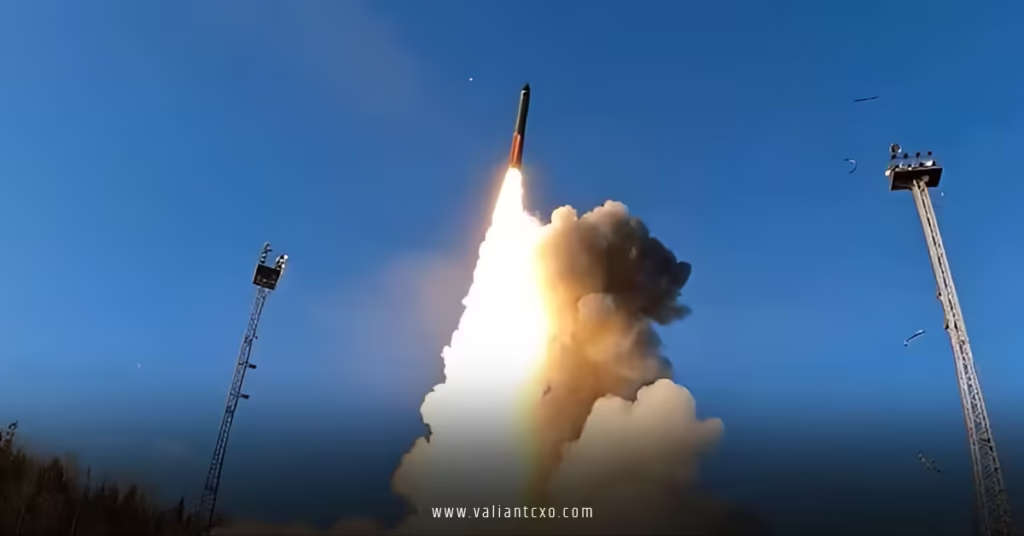
Okay, let’s zero in on the event that’s got headlines buzzing. Russia’s Burevestnik nuclear-powered cruise missile test October 2025 wasn’t some quiet lab experiment—it was a high-stakes demo, launched from a frosty site above the Arctic Circle. On October 21, under Gerasimov’s watchful eye, this missile took to the skies, and boy, did it deliver.
Launch Day Drama: 15 Hours of Fury
Imagine the tension at the Kapustin Yar range or maybe Pan’kovo on Novaya Zemlya—wind howling, techs in fur-lined coats counting down. Boom: ignition. The Burevestnik blasts off, its nuclear heart humming as it climbs, then dips low to ghost over oceans and landmasses. For a full 15 hours, it cruised 14,000 kilometers— that’s from Moscow to New York and back, with detours. It twisted and turned, testing evasion tactics that make interceptors weep.
Gerasimov spilled the beans via TASS: “Not the limit,” he boasted, hinting at 20,000 km potential. No crashes, no leaks reported this time. It’s like the missile finally shed its jinx, evolving from a clunky prototype to a sleek predator. But here’s the kicker—independent verification? Crickets. Still, satellite imagery from earlier in 2025 showed prep work, so yeah, this happened.
Putin’s Take: Victory Lap or Psy-Ops?
Enter Vladimir Putin, stage right, during a powwow with top brass. “Success!” he declares, eyes gleaming like a kid with a new toy. He ties it to broader drills—Yars ICBMs, Sineva subs, Kh-102 cruises—all firing in sync to flex Russia’s nuclear muscles. It’s no coincidence; with Ukraine simmering and Trump back in the White House, this feels like a message: “Don’t poke the bear.”
But is it all smoke? Past claims, like a 2023 “final test,” fizzled without proof. Russia’s Burevestnik nuclear-powered cruise missile test October 2025 feels different—tangible progress toward deployment by 2027. Putin ordered infrastructure hunts, meaning silos or subs could soon host these beasts. Chilling, right?
Global Ripples: How Russia’s Burevestnik Nuclear-Powered Cruise Missile Test October 2025 Shakes the World
You can’t drop a nuclear-powered missile bombshell without fallout—literal or figurative. This test isn’t isolated; it’s a thread in the tapestry of modern deterrence. As a guy who’s pored over arms reports, I see it amplifying fears in boardrooms from D.C. to Delhi.
Moscow’s Angle: Deterrence on Steroids
From Russia’s view, it’s genius. Why? It counters U.S. missile shields, ensuring second-strike power even if defenses evolve. Putin frames it as defensive—protecting sovereignty amid NATO’s eastward creep. And with New START teetering (Russia suspended it in 2023), this ups the ante for talks. Extend the treaty? Sure, but play nice, America.
Analogy time: It’s like Russia building a moat around its nukes, but the moat’s on fire and radioactive. Smart for survival, scary for stability.
The West’s Worry: Arms Race Reloaded
Flip the coin, and Western experts are sweating. Jeffrey Lewis calls it a “tiny flying Chernobyl”—cute, but deadly. Why? That nuclear engine spews fallout if it fails, risking Russia’s own turf. Hanna Notte sees it as saber-rattling aimed at Washington, lowering nukes’ taboo amid hybrid threats.
NATO’s buzzing; the U.S. Air Force once praised its “unique” range, but now? Panic. Imagine loitering missiles orbiting borders—escalation city. For more on the reactions, check out this in-depth BBC analysis. And the New York Times breakdown nails the expert takes.
Pavel Podvig questions its smarts: Why risk detection on long flights when ICBMs are faster? Fair point, but in Putin’s playbook, fear trumps logic.
The Dark Side: Why “Flying Chernobyl” Sticks
Ah, the nickname. “Flying Chernobyl” isn’t just snarky—it’s a gut-punch reminder of risks. Remember 1986? That reactor meltdown poisoned swaths of Ukraine. Now, strap one to a missile: exhaust trails laced with isotopes, crash sites glowing for decades.
The 2019 Nyonoksa blast? Linked to Burevestnik recovery, it spiked radiation levels, forcing evacuations. Experts like those at the Nuclear Threat Initiative tally 13 tests since 2016—only two partial wins. Russia’s Burevestnik nuclear-powered cruise missile test October 2025 dodged disaster, but one slip? Catastrophe.
It’s like handing a toddler a lit match: potent, but perilously dumb. U.S. ditched similar ideas in the ’60s for good reason. Dive deeper into the tech history via the comprehensive Wikipedia page.
Looking Ahead: Deployment Dreams and Doomsday Drills
So, what’s next post-Russia’s Burevestnik nuclear-powered cruise missile test October 2025? Putin wants it fielded ASAP—think 2027 adoption, per insiders. Sites like Vologda-20 are prepping, satellites spotting rail shelters for nuke tests.
But hurdles loom: tech glitches, costs (billions sunk already), and arms control pleas. Will it join patrols, circling like a vulture? Or fizzle like past wonders? I bet on hybrid use—deterrence plus psy-ops.
Rhetorical nudge: In a world of drones and hypersonics, does another doomsday toy unite us or divide further? Time will tell.
Wrapping It Up: Navigating the Nuclear New Normal
Whew, we’ve covered a lot—from the gritty origins of the Burevestnik to the pulse-pounding details of Russia’s Burevestnik nuclear-powered cruise missile test October 2025. This 15-hour, 14,000-km jaunt isn’t just a win for Moscow; it’s a flare in the dark, signaling an arms race that’s far from over. We’ve seen the tech marvels, the hair-raising risks (hello, Flying Chernobyl vibes), and the global jitters that could tip balances.
Here’s the motivator: Knowledge is your shield. Stay informed, push for diplomacy—because in this game, we’re all players. Whether it’s New START extensions or tech-sharing pacts, your voice counts. Russia’s Burevestnik nuclear-powered cruise missile test October 2025 reminds us: Peace isn’t passive; it’s proactive. What’s your take? Drop a comment below.
Frequently Asked Questions (FAQs)
What exactly happened during Russia’s Burevestnik nuclear-powered cruise missile test October 2025?
On October 21, 2025, Russia launched the missile from an Arctic site, where it flew for 15 hours, covering 14,000 km with successful evasion maneuvers. Officials hailed it as a breakthrough, but details remain Kremlin-guarded.
Is the Burevestnik missile really unlimited in range, as claimed after Russia’s Burevestnik nuclear-powered cruise missile test October 2025?
Thanks to its nuclear propulsion, yes—in theory. The test proved intercontinental stamina, but real-world factors like weather or defenses could cap it at 20,000 km max.
Why is Russia’s Burevestnik nuclear-powered cruise missile test October 2025 causing international alarm?
It escalates nuclear risks, evades defenses, and hints at deployment, fueling arms race fears. Experts worry about fallout from failures, dubbing it destabilizing in tense times.
How does Russia’s Burevestnik nuclear-powered cruise missile test October 2025 fit into Putin’s broader strategy?
It’s a deterrence signal amid Ukraine and U.S. tensions, showcasing Russia’s tech edge to negotiate from strength, like on New START treaty extensions.
Will we see the Burevestnik deployed soon after Russia’s Burevestnik nuclear-powered cruise missile test October 2025?
Putin aims for 2027 integration, with infrastructure underway. But past delays suggest more tests first—watch for Arctic activity.
For More Updates !! : valiantcxo.com