
Becoming a U.S. citizen isn’t just about passing one test. It’s a full legal process, several key decisions, and a timeline that can stretch for months. That’s where a clear, no-nonsense USCIS naturalization guide pays off.
If you want one simple rule, it’s this: treat naturalization like a project with steps, deadlines, and required documents—not a mystery.
Quick overview: what the USCIS naturalization process really involves
Within the first minute, you should know exactly what you’re signing up for. Here’s the snapshot.
- You must meet eligibility rules (green card time, physical presence, good moral character).
- You submit Form N-400, pay fees, and provide supporting documents.
- You attend biometrics, then a USCIS interview with English and civics testing.
- You pass the civics exam, often based on the official 2026 US citizenship test 128 civics questions and answers study set.
- You take the Oath of Allegiance, and only then are you officially a U.S. citizen.
The process is structured, not random. If you understand the structure, you control the outcome a lot more than you think.
Who is eligible to naturalize?
USCIS naturalization rules look complicated on paper, but under the hood the core questions are simple:
- How long have you had your green card?
- Where have you been living and traveling?
- Do you meet behavior and tax requirements?
- Can you handle basic English and civics?
Basic eligibility paths
Most people fall into one of these buckets:
- 5-year permanent residents
- You’ve had a green card for at least 5 years.
- You’ve been physically present in the U.S. for at least half that time.
- You’ve lived in your current USCIS district or state for at least 3 months.
- 3-year rule for spouses of U.S. citizens
- You’ve been a permanent resident for at least 3 years.
- You’ve been married to and living with the same U.S. citizen spouse for those 3 years.
- Your spouse has been a U.S. citizen for that period.
- Special categories
- Certain military service members.
- Some other narrow categories with slightly different rules.
If you’re not sure which lane you’re in, start with your green card issue date and work outward: that’s your anchor.
For the most accurate, current criteria, the USCIS Citizenship and Naturalization section lays out the official eligibility rules in detail.
Step-by-step USCIS naturalization guide
Here’s the clean, practical path from “thinking about applying” to “holding a naturalization certificate.”
Step 1: Confirm your eligibility
Before you touch any form, check:
- Continuous residence and physical presence
- Time as a permanent resident
- Marital status and history (if using the 3-year rule)
- Past criminal or immigration issues
- Tax filings and selective service registration (for some male applicants)
In my experience, people lose time trying to force an early filing when they’re not quite eligible yet. Better to wait a month than get denied and reset the clock.
Step 2: Gather your documents
Build a small “naturalization folder.” You’ll probably need:
- Green card (front and back copy)
- Passports and travel history details
- Marriage and divorce records (if applicable)
- Tax returns or transcripts for recent years
- Proof of spouse’s citizenship (if using the 3-year rule)
- Any court records or dispositions if you’ve ever been arrested or charged
The stronger and clearer your documentation, the smoother your interview tends to be.
Step 3: Complete Form N-400
Form N-400 is the main naturalization application. You can file online or on paper.
You’ll be asked about:
- Biographical information
- Residence and work history
- Travel outside the U.S.
- Family information
- Criminal and security-related questions
Answer honestly and carefully. If something looks tricky—like long trips outside the U.S. or old legal issues—consider talking to an immigration professional before filing.
Step 4: Pay the fees and submit
Naturalization usually involves a filing fee and a biometrics fee. Fees can change, so always confirm with the USCIS filing fees page before you send anything.
Once you file:
- You receive a receipt notice with your case number.
- You can track your case through the USCIS online account system.
From this point, think of yourself as “in the pipeline.” You’re not just waiting; you’re preparing for the next steps.
Step 5: Biometrics appointment
USCIS schedules you for a biometrics appointment where they take your fingerprints and photo for background checks.
It’s typically quick, but you must attend or properly reschedule. Missing it without notice can stall your case.
Step 6: The interview (and tests)
At your naturalization interview, a USCIS officer:
- Reviews your N-400 answers
- Checks your eligibility and documents
- Administers the English test (reading and writing)
- Administers the civics test
The civics test is where the 2026 US citizenship test 128 civics questions and answers usually comes in. That set is your core study guide for the government and history questions the officer will ask out loud.
If you’re nervous? That’s normal. What usually helps is practicing mock interviews and answering aloud until the answers feel automatic.
Step 7: Decision and recommendations
After the interview, the officer may:
- Approve your application
- Continue it (ask for more documents or another interview)
- Recommend denial
If approved, you’ll be scheduled for an Oath of Allegiance ceremony. Until you take the oath, you are not yet a U.S. citizen, even if everything else went perfectly.
Step 8: Oath ceremony
The oath is the final act.
At the ceremony:
- You turn in your green card.
- You take the Oath of Allegiance.
- You receive your Certificate of Naturalization.
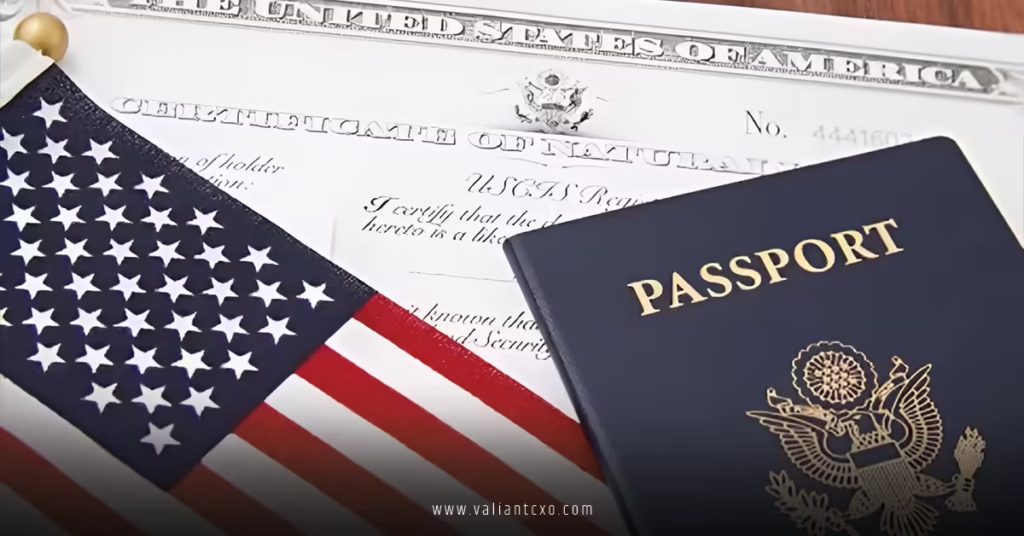
That certificate is what you’ll use to apply for a U.S. passport and update your status with agencies and employers.
Naturalization timeline vs. tasks: a practical breakdown
Here’s a high-level timing guide. It’s an estimate, not a promise—local USCIS workloads matter a lot.
| Stage | What you do | Typical Timeframe* |
|---|---|---|
| Pre-application | Check eligibility, gather documents | 1–4 weeks (self-paced) |
| File N-400 | Submit form, pay fees | 1 day (once ready) |
| Biometrics | Attend fingerprint appointment | About 3–8 weeks after filing |
| Interview + tests | USCIS interview, English and civics exams | Several months after biometrics, varies by field office |
| Decision | Approval, continuation, or denial | Often same day as interview or shortly after |
| Oath ceremony | Take the oath, receive certificate | Weeks after approval, sometimes same day |
*Always verify current processing times using the USCIS processing times tool, as they change by location and workload.
English and civics: what you really need to prepare
The USCIS naturalization guide isn’t complete without the test strategy piece. Passing the civics and English tests is where most of the pressure lands.
English test basics
The English portion usually includes:
- Speaking: evaluated during the interview
- Reading: reading one simple sentence aloud
- Writing: writing one simple sentence correctly
Many people worry about “perfect” English. In my experience, officers are checking for functional communication, not flawless grammar.
Civics test basics (and the 128 questions)
The civics test is:
- Oral (the officer asks; you answer out loud)
- Based on the official civics question list
- Focused on U.S. government, history, and civic values
The 2026 US citizenship test 128 civics questions and answers is your main study framework. Instead of chasing random quizzes, stick to that official scope and practice until you can answer confidently, in your own words, without notes.
Common mistakes in the naturalization process (and how to fix them)
Every year, people delay or risk their naturalization for avoidable reasons. Let’s not do that.
Mistake 1: Filing before truly eligible
Some applicants rush the timeline and file too early based on bad advice.
Fix: Confirm eligibility dates using your green card issue date and official USCIS guidelines. When in doubt, verify with an attorney or an accredited representative.
Mistake 2: Incomplete travel or address history
Gaps or contradictions in your N-400 can raise questions at the interview.
Fix: Use your passports, old tickets, email receipts, and calendar to rebuild travel history. Be consistent across all sections.
Mistake 3: Ignoring tax and selective service issues
Unpaid taxes or missing selective service registration (for certain age groups and years) can cause serious trouble.
Fix: Resolve tax debts or set up formal payment arrangements before filing. If you missed selective service registration, gather evidence and, if needed, seek legal guidance on how to explain it.
Mistake 4: Underestimating the civics test
Some applicants assume the civics portion will be “easy enough” and only skim it.
Fix: Treat the civics prep as non-negotiable. Use the 2026 US citizenship test 128 civics questions and answers as your structured study guide and practice under interview-like conditions.
Mistake 5: Not bringing the right documents to the interview
Showing up with missing evidence can lead to delays or a continued case.
Fix: Carefully review your interview notice. Bring originals and copies of everything USCIS requests, plus anything relevant to updates since you filed.
Smart prep tips that actually work
If you want a smoother naturalization journey, focus on habits, not hacks.
- Set a weekly “citizenship block”
One or two dedicated slots per week for paperwork, study, and practice keeps you moving steadily. - Practice civics aloud, not silently
The test is oral. Answering out loud trains your brain and your mouth to work together under pressure. - Build a “problem list”
Any confusing questions, legal issues, or tricky N-400 items go on a list. Address them early—don’t wait until interview day. - Use official sources as your baseline
Third-party sites can help, but USCIS is the reference standard. Always cross-check. - Simulate the interview
Have a friend or family member ask civics questions and basic N-400 questions at natural speed. No notes, no pause button.
Think of the process like training for a 5K race. You don’t need to be an Olympic runner, but you should be able to jog the distance without stopping. Consistent preparation gets you there.
Key takeaways
- The USCIS naturalization guide is essentially a roadmap from permanent resident to full U.S. citizen.
- Eligibility depends on time with a green card, residence, behavior, and basic language/civics abilities.
- Form N-400, biometrics, the interview, and the oath are the four big milestones.
- The civics exam is best prepared for using the official 2026 US citizenship test 128 civics questions and answers as your core study set.
- Honest, complete information on your N-400 is just as important as test prep.
- Short, consistent study and preparation beats last-minute cramming every time.
- Official USCIS resources should be your primary reference, with anything else checked against them.
- You’re not just chasing a certificate—you’re building the foundation for your rights and responsibilities as a future U.S. citizen.
FAQs
How long does the USCIS naturalization process usually take?
Processing times vary by USCIS field office and workload, but many applicants see the full process—from N-400 filing to oath ceremony—take several months to over a year. Checking your local USCIS office’s processing times is the best way to set realistic expectations.
Do I have to pass both the English and civics tests to naturalize?
In most cases, yes. Applicants need to demonstrate basic English ability and pass the civics test, which is typically based on study materials like the 2026 US citizenship test 128 civics questions and answers. Some age and disability-based exceptions or accommodations may apply.
When should I start studying for the civics exam in the USCIS naturalization process?
Start as soon as you file—or even slightly before. Using the 2026 US citizenship test 128 civics questions and answers early gives you plenty of time to build confidence, especially if English is not your first language or tests make you nervous.