Dassault Rafale specifications and range put this French omnirole fighter in a league of its own for operators who need one jet to handle air superiority, deep strike, reconnaissance, and nuclear deterrence without swapping platforms. Here’s the quick breakdown of what matters most:
- Twin Safran M88 engines deliver roughly 50 kN dry and 75 kN with afterburner each, pushing the jet to Mach 1.8 at altitude.
- Ferry range hits 3,700 km with three external tanks; combat radius on a penetration mission sits around 1,850 km.
- Empty weight stays in the 10-ton class while max takeoff weight reaches 24,500 kg and external payload tops 9,500 kg.
- Fourteen hardpoints (thirteen on the naval version) and a 30 mm cannon give it serious teeth across every mission set.
- Continuous upgrades through F4 and the coming F5 keep the jet relevant well past 2030.
Those numbers explain why air forces from India to the UAE keep writing checks. The jet does not chase pure stealth. It bets on sensor fusion, SPECTRA electronic warfare, and raw payload-to-weight muscle instead.
Core Dassault Rafale specifications and range numbers
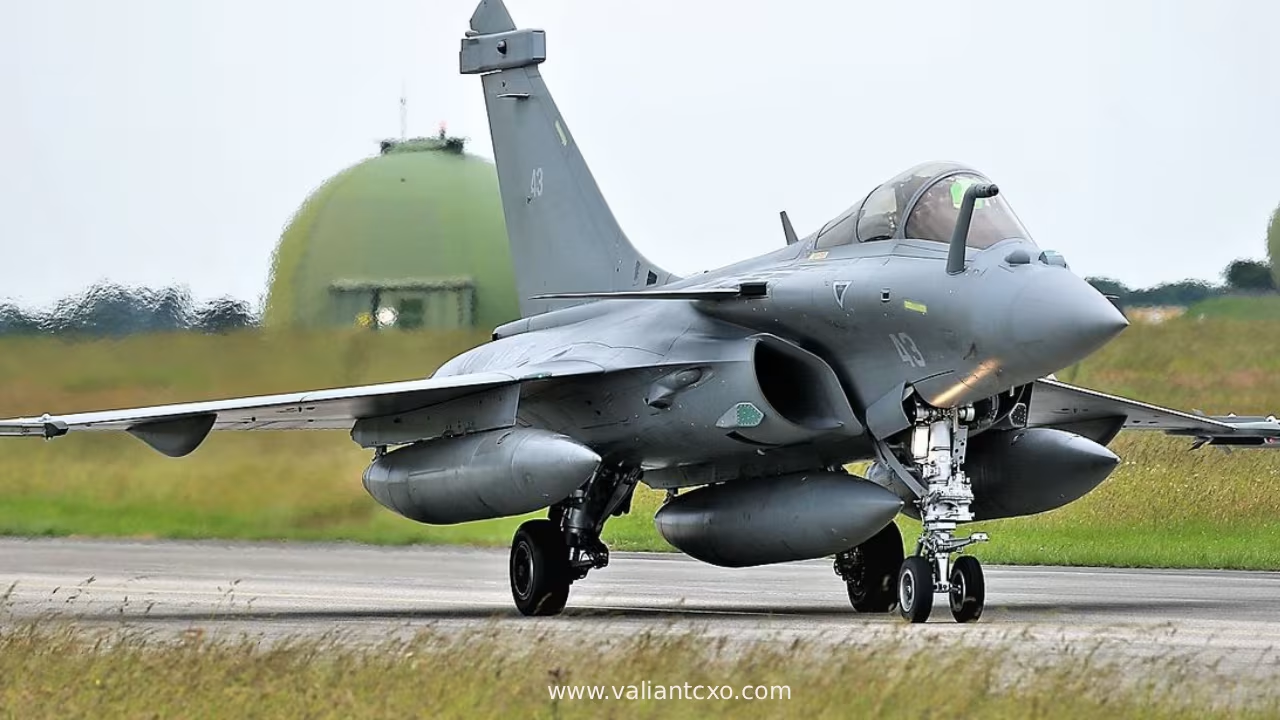
Look at the airframe first. Length runs 15.27–15.30 m. Wingspan is 10.90 m. Height sits at 5.30–5.34 m. Wing area measures 45.7 m². That delta-canard layout gives high instantaneous turn rate and excellent low-speed handling for carrier traps or short-field ops.
Empty weight varies by variant. The single-seat C comes in around 9,850 kg. The two-seat B is closer to 10,300 kg. The naval M tips the scales near 10,600 kg thanks to the stronger landing gear and tailhook. Maximum takeoff weight holds at 24,500 kg across the land-based models. Internal fuel is about 4,700 kg on the single-seater. External tanks can add another 6,700 kg or more.
Dassault Rafale specifications and range Power comes from two Safran M88-2 turbofans. Dry thrust is listed at 50.04 kN (11,250 lbf) each. Afterburner jumps that to 75 kN (17,000 lbf). Thrust-to-weight in a typical air-to-air load sits near 1.1. Service ceiling is 15,835 m (about 52,000 ft). Rate of climb exceeds 300 m/s. G limits are +9 / –3.2 (or –3.6 depending on the source). Approach speed stays under 120 knots, and landing ground run without a drag chute is roughly 450 m.
Maximum speed is Mach 1.8 at altitude—about 1,912 km/h. At low level it still hits Mach 1.1. Supercruise is real: the jet can hold Mach 1.4 with a useful missile load without lighting the burners. That matters when you want to stay quiet and save fuel.
Range is the number everyone asks about. Ferry range with three drop tanks reaches 3,700 km (2,000 nautical miles). Combat radius on a penetration mission with three tanks is commonly quoted at 1,850 km (1,000 nmi). Combat air patrol loiter time can stretch past three hours. Aerial refueling is standard, of course, and the Rafale can even buddy-refuel another Rafale when tankers are scarce.
| Specification | Value | Notes |
|---|---|---|
| Length | 15.27–15.30 m | All variants |
| Wingspan | 10.90 m | Includes wingtip launchers |
| Empty weight | 9,850–10,600 kg | C / B / M variants |
| Max takeoff weight | 24,500 kg | Land versions |
| Engines | 2 × Safran M88-2 | 50 kN dry / 75 kN AB each |
| Max speed | Mach 1.8 | High altitude |
| Ferry range | 3,700 km | With 3 drop tanks |
| Combat radius | ~1,850 km | Penetration mission |
| External payload | 9,500 kg | 14 hardpoints (13 on M) |
| Service ceiling | 15,835 m | Approx. 52,000 ft |
These figures come straight from Dassault data sheets and consistent open-source reporting. They have held steady through the F3R and early F4 standards. The F5 standard now in development will bring a more powerful M88 T-REX engine aiming for roughly 9 tonnes of thrust each, plus new sensors and the ability to carry the future ASN4G nuclear missile. Range and payload should only improve.
How the numbers translate in the real world
In my experience watching export campaigns, the payload-to-weight ratio is the quiet killer. A 10-ton empty jet that can hang 9.5 tons of stores is rare. Most competitors force you to choose between fuel and weapons. The Rafale lets you take both for longer.
Dassault Rafale specifications and range Sensor suite matters just as much as the engines. The RBE2 AESA radar tracks dozens of targets and can engage multiple threats at once. The OSF infrared search-and-track system works passively. SPECTRA handles electronic warfare and self-protection. Put those together and the jet sees first, shoots first, and stays harder to kill.
Operators in hot climates—India, Egypt, the Gulf—appreciate the M88’s reliability and relatively modest logistics footprint. Twin engines also give a safety margin that single-engine jets simply cannot match over water or desert.
Step-by-step: understanding Dassault Rafale specifications and range for beginners
- Start with the mission profile. Air-to-air CAP needs more fuel and fewer bombs. Deep strike flips that equation. Decide the job first.
- Check the published combat radius against your theater distances. Add a healthy margin for weather, threats, and the need to return with fuel reserves.
- Factor in aerial refueling. The Rafale’s probe makes tanking straightforward, but plan the tanker orbits early.
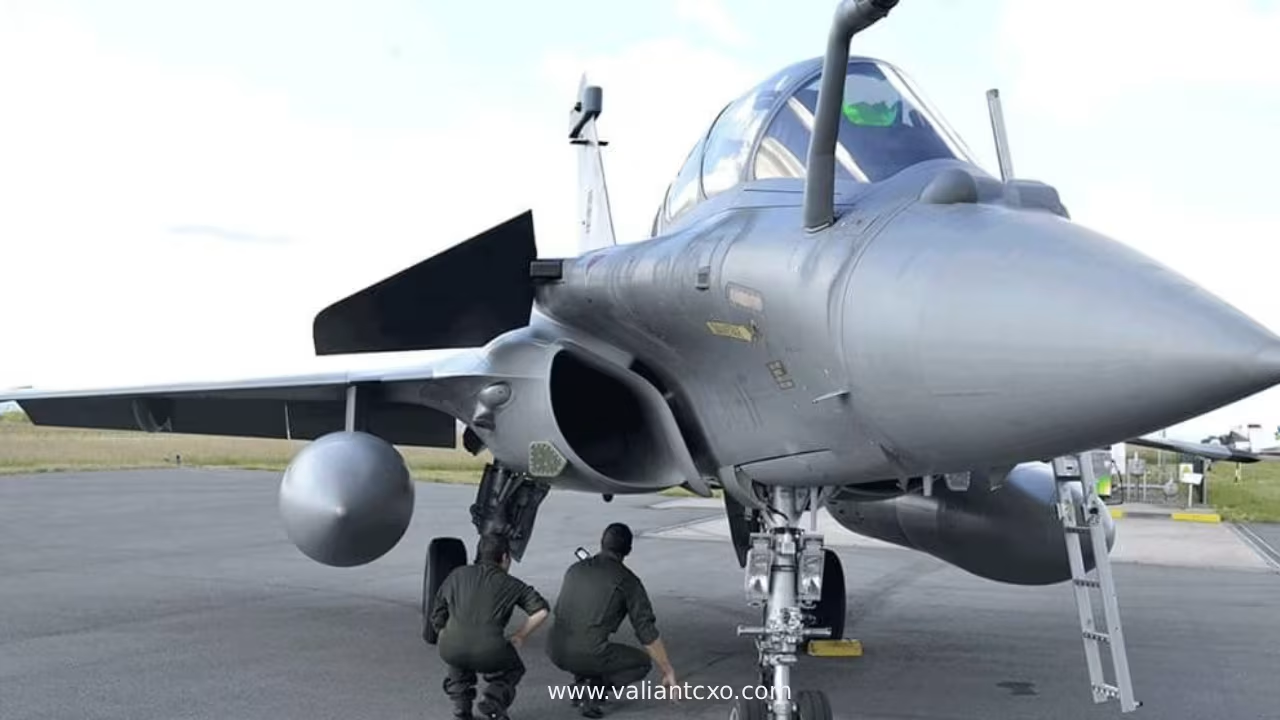
- Look at the hardpoint layout. Five “wet” stations carry heavy tanks or large weapons. The rest handle missiles and lighter stores.
- Review the current standard—F3R, F4, or the upcoming F5. Avionics and weapons clearances change the effective range more than the airframe itself.
- Talk to operators who already fly it. India and Egypt have real-world data on hot-and-high performance and maintenance hours.
Do those six steps and the glossy brochure numbers start making practical sense.
Common mistakes people make with the range figures
People treat the 3,700 km ferry range as a combat number. It is not. That figure assumes clean tanks and minimal weapons. Real missions burn fuel for self-defense, radar time, and tactical maneuvering.
Another frequent error is ignoring configuration drag. Six air-to-air missiles plus a centerline tank still allows supercruise, but load the jet with SCALP cruise missiles and heavy bombs and the radius shrinks fast.
Some analysts also forget the naval version’s weight penalty. The Rafale M is a bit heavier and has one fewer hardpoint. Its combat radius is close but not identical to the land-based jets.
Finally, treating the numbers as static. Dassault keeps upgrading engines, software, and weapons. What was true for the early F2 standard is already outdated for F4 aircraft rolling off the line in 2026.
Why the range and payload combination still wins contracts
The Rafale does not try to be the F-35. It does not need to. For countries that want sovereign control over maintenance, weapons integration, and future upgrades, the French jet delivers. Egypt, Qatar, Greece, Croatia, Indonesia, the UAE, and Serbia all bought in for different reasons, yet the shared thread is the ability to do multiple jobs with one airframe.
In a high-threat environment the SPECTRA suite and sensor fusion often matter more than a few extra kilometers of range. Still, having that 1,850 km combat radius in your back pocket means fewer tanker sorties and more flexibility when the tankers are busy elsewhere.
What would I do if I were advising a mid-sized air force right now? I would put the Rafale on the shortlist purely on the published Dassault Rafale specifications and range, then dig into the total ownership cost and the political reliability of the supply chain. Those two factors decide more deals than pure kinematics ever will.
Key Takeaways
- Ferry range of 3,700 km and combat radius near 1,850 km remain competitive in 2026.
- Twin M88 engines give both performance and a safety margin single-engine fighters lack.
- 9,500 kg external payload on 14 hardpoints is exceptional for a 10-ton-class jet.
- Continuous F-series upgrades keep the platform current without a full redesign.
- Omnirole design means one jet type covers air-to-air, strike, recon, and deterrence.
- Real-world operators value reliability and sovereign support as much as the raw numbers.
- The coming F5 standard with more powerful engines will stretch these figures further.
The Rafale still punches above its weight because the designers refused to specialize. One airframe, many missions, solid range, and a weapons bay that is basically the entire underside of the jet. If you need a fighter that can leave home base, hit a target hundreds of kilometers away, and still have gas to fight its way out, the published Dassault Rafale specifications and range show exactly why so many air forces keep saying yes.
Next step? Pull the latest Dassault data sheet for the exact standard you are evaluating and run the numbers against your actual theater distances. The brochure is good. Your mission profile is better.
FAQs
What is the current combat radius in the latest Dassault Rafale specifications and range figures?
Official figures still list approximately 1,850 km (1,000 nmi) on a penetration mission with three external tanks. Actual radius varies with weapons load, altitude profile, and whether the jet is using afterburner or supercruise.
How does the naval Rafale M differ in range from the land-based versions?
The M is slightly heavier due to structural reinforcements and has one fewer hardpoint. Ferry and combat ranges remain very close to the C and B models, but every kilogram counts on a carrier deck.
Will the F5 standard change the Dassault Rafale specifications and range significantly?
The planned M88 T-REX engines target roughly 20 % more thrust. Combined with refined aerodynamics and new weapons, both payload and effective range should improve when the F5 reaches service in the early 2030s.