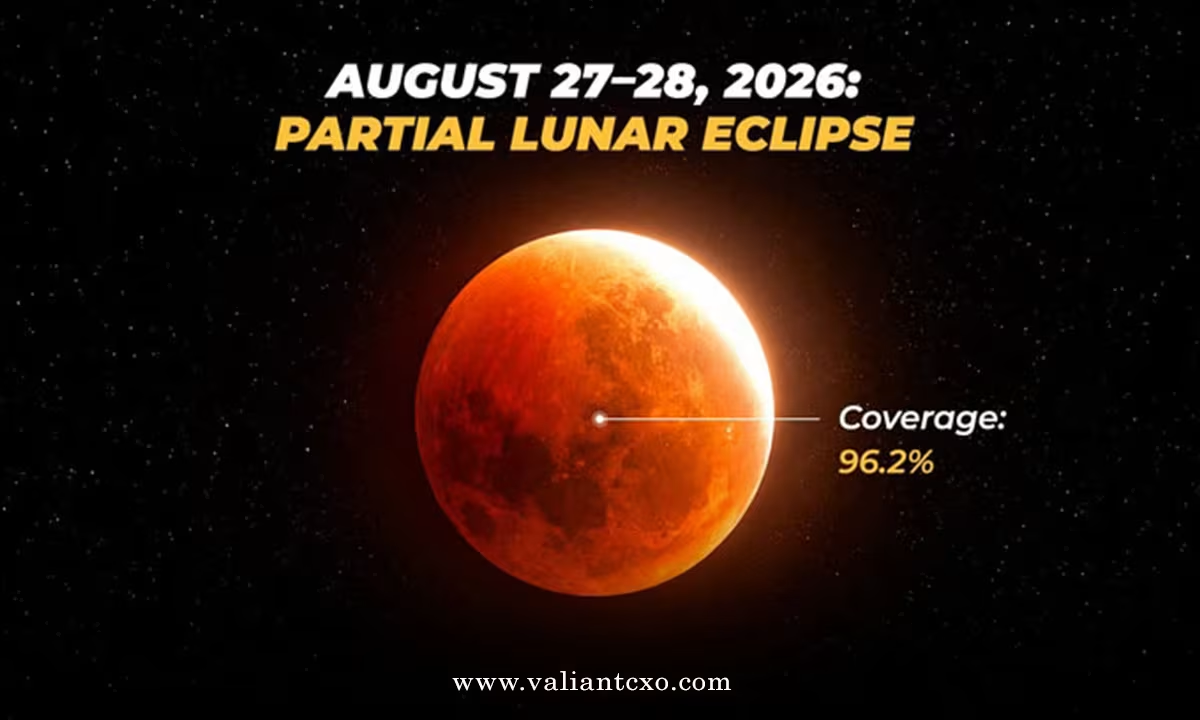
The next lunar eclipse after 2026 arrives sooner than most people think. Right after the deep 96% partial on August 27–28, 2026, the calendar shifts to quieter penumbral events before the real drama returns.
If you just finished planning how to watch the 96% blood moon partial lunar eclipse August 27-28 2026, this guide picks up exactly where that one left off. Here’s the clear sequence so you know what comes next and which nights are actually worth staying up for.
Quick Overview of the Next Lunar Eclipses
- February 20–21, 2027: Penumbral – subtle shading only
- July 18, 2027: Penumbral – extremely faint
- August 16–17, 2027: Penumbral – still mild
- January 11–12, 2028: Partial – very shallow (only ~6–7% of the Moon in the umbra)
- July 6, 2028: Partial – deeper but still modest
- December 31, 2028 – January 1, 2029: Total – the next true blood moon
NASA data confirms no total lunar eclipse occurs in 2027 at all. The first total after the 2026 events lands on New Year’s Eve 2028.
2027: The Quiet Year of Penumbral Eclipses
Penumbral eclipses happen when the Moon only grazes Earth’s outer shadow. The dimming is so slight that casual observers often miss it unless they know exactly what to look for.
February 20–21, 2027
Visible across the Americas, Europe, Africa, and Asia. The Moon simply looks a bit dingier on one side for a few hours. No red color. No dramatic “bite.” Most people will need before-and-after photos to notice the change.
July 18 and August 16–17, 2027
Even milder. These sit near the edge of visibility for many locations. In my experience, these are the events you mark on a calendar only if you’re already outside for other reasons.
Skip the late nights in 2027 unless you’re a dedicated eclipse collector. Save your energy for 2028.
2028: Partials Build Toward the Main Event
January 11–12, 2028 – Shallow Partial
Umbral magnitude around 0.066. Only a tiny dark notch appears on the Moon’s edge. Visible from the Americas, Europe, and Africa. It’s technically a partial, but the visual impact is modest. Think of it as a practice run.
July 6, 2028 – Deeper Partial
Better. Roughly 39% of the Moon’s diameter enters the umbra. Europe, Africa, Asia, and Australia get the best views. North America sees limited portions depending on timing. Still no full blood-moon effect, but the shadow edge is clear and photogenic.
Then comes the one that matters.
December 31, 2028 – January 1, 2029: The Next Total Lunar Eclipse
This is the first total lunar eclipse after 2026. Greatest eclipse occurs at 16:52 UTC on December 31. Totality lasts about 1 hour 11 minutes. The Moon will pass deep into Earth’s umbra (magnitude ~1.25), producing the classic copper-to-blood-red glow.
Visibility highlights
- Excellent across Europe, Africa, Asia, and Australia
- Partial visibility in northwestern North America and the Pacific
- Eastern North America and South America largely miss it because the Moon is below the horizon
For U.S. West Coast observers, the eclipse will already be underway at moonrise or early evening. Eastern states get little to none of the total phase. The next total with strong North American coverage arrives June 26, 2029.
Comparison Table: Key Lunar Eclipses 2026–2029
| Date | Type | Peak Coverage / Totality | Best for North America? | Notes |
|---|---|---|---|---|
| Aug 27–28, 2026 | Deep Partial | 96% | Excellent | Near-blood moon look |
| Feb 20–21, 2027 | Penumbral | Subtle | Fair | Easy to miss |
| Jan 11–12, 2028 | Shallow Partial | ~7% | Good | Minor notch |
| Jul 6, 2028 | Partial | ~39% | Limited | Clear shadow edge |
| Dec 31, 2028–Jan 1, 2029 | Total | 1h 11m totality | West only | True blood moon |
| Jun 26, 2029 | Total | 1h 42m totality | Excellent | Longest near-term |
How to Prepare for the Next Worthwhile Events
Treat the 2026 deep partial as your baseline. The same rules apply: clear skies beat fancy gear, arrive early, and let your eyes adapt. For the December 2028 total, check local moonrise times carefully if you’re in western North America. A simple pair of 7×50 or 10×50 binoculars will show the color shift dramatically once totality begins.
What I’d do differently after the 2026 event: keep a running note of cloud-cover statistics for your usual observing spots. The difference between a “partly cloudy” forecast and actual gaps can decide whether you see red or nothing at all.
Why the Gap Between Deep Events Feels Long
Lunar eclipses come in cycles. After the strong 2026 partial, orbital geometry produces only faint penumbrals and shallow partials for two years. The December 2028 total resets the board. Then 2029 delivers two more totals, including one with excellent Americas visibility.
Most casual skywatchers only need to mark three nights between now and mid-2029: the August 2026 deep partial, the December 2028 total, and the June 2029 total. Everything else is optional.
Practical Tips for Tracking Future Eclipses
Bookmark NASA’s eclipse pages or Time and Date’s lunar list. Both update local times automatically. Set calendar alerts six months out for the major ones. And remember—lunar eclipses are always safe for naked-eye viewing. No filters required.
The next lunar eclipse after 2026 starts with those quiet 2027 penumbrals, builds through the 2028 partials, and peaks with the New Year’s Eve total. If the August 2026 event left you wanting more red, December 31, 2028 is the date that finally delivers a full blood moon again.
Mark it now. Clear skies are never guaranteed, but the calendar is.